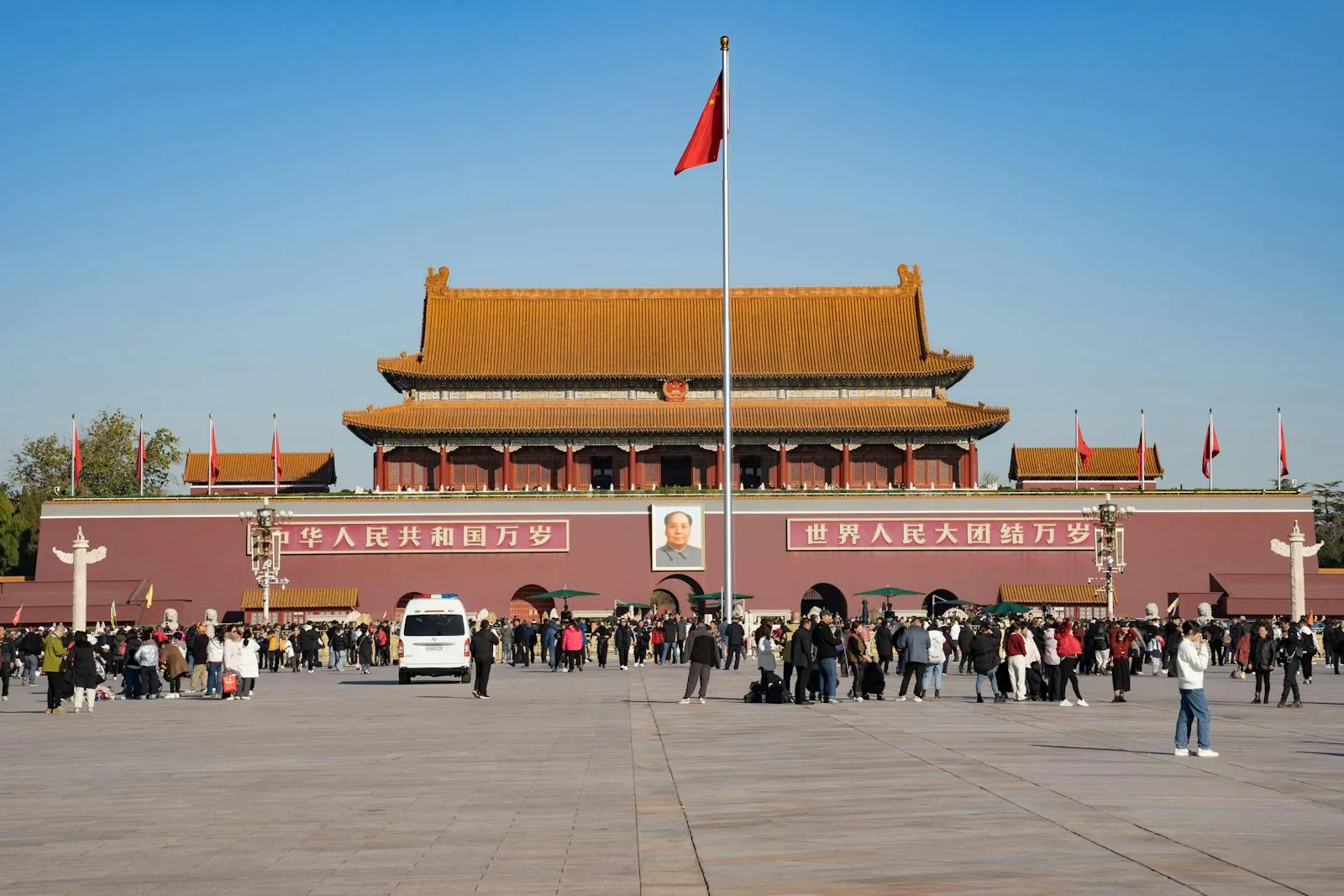
Russian President Vladimir Putin arrived in Beijing on Wednesday for his 25th visit to China, and left with a 47-page joint declaration, 40 cooperation agreements, and a co-signed warning to Washington that the two countries will resist what they called a return to the “law of the jungle” in global affairs.
The summit with Chinese President Xi Jinping came four days after President Donald Trump completed his own Beijing visit — the first in his second term — in which the two sides declared a pause in trade hostilities and pledged cooperation on Iran. Putin’s trip, arranged weeks before Trump’s, underscored the diplomatic competition at the center of Chinese foreign policy: Beijing is simultaneously deepening its strategic alignment with Moscow while managing an economic relationship with Washington that neither side can afford to abandon.
“China-Russia relations have now reached the highest level in history,” Xi said at a joint press appearance with Putin at the Great Hall of the People. Putin called the partnership a “record high” and said the visit confirmed that the two countries’ coordination had become a structural feature of international relations, not an opportunistic response to Western pressure.
What the Declaration Says
The 47-page joint statement is the most comprehensive document the two governments have produced since at least 2023. Its core framing — a call for “a multipolar world and a new type of international relations” — is language both leaders have used in bilateral contexts for years, but this document offers more specific policy commitments than prior iterations.
The most pointed section targets Trump’s proposed “Golden Dome” missile defense system. In their joint statement, Xi and Putin said the planned $175 billion ground-and-space-based interceptor network would “undermine global strategic stability” by giving one country first-strike confidence and degrading the deterrence logic that has constrained nuclear competition since the Cold War. The statement does not name the United States by name in this passage — the phrasing of Chinese diplomacy rarely does — but the reference is unambiguous: Trump announced the Golden Dome architecture in February, and the Kremlin’s opposition to it has been a consistent public position.
The declaration also contains the two leaders’ first coordinated written position on the Ukraine war since the conflict moved into its ceasefire phase. The key phrase is “root causes of the Ukrainian crisis” — language that implies the war’s origins predate Russia’s February 2022 invasion and that positions a negotiated outcome as requiring structural change, not simply a Russian withdrawal. Ukraine and its Western backers have rejected that framing since the earliest days of the war. By embedding it in a formal joint statement, Beijing is putting its name on the Russian narrative of the conflict’s origins for the first time in explicit written form.
The declaration extends visa-free travel for citizens of both countries through 2027.
Forty Agreements, One Unresolved Pipeline
Beyond the declaration itself, the two sides signed 20 bilateral agreements during Wednesday’s ceremony at the Great Hall of the People, with an additional 20 expected to be formalized through diplomatic channels in the coming weeks. The agreements cover trade, technology, media, film, scientific research, talent exchanges, joint innovation, and artificial intelligence cooperation.
The most watched potential deal — and the one that most clearly did not come together — was the Power of Siberia 2 natural gas pipeline. The proposed pipeline would carry Russian gas through Mongolia to China and would give Moscow a large alternative export route if European demand remains depressed. The two sides have been negotiating the project for years, and analysts had expected the summit to produce at least a heads-of-agreement document.
It didn’t. Kremlin spokesperson Dmitry Peskov told Russian media that the two governments had reached “a basic understanding” on the pipeline, including its route, but that there is “no clear timeline” for construction. The sticking point is pricing: Russia wants terms near those of its pre-war European contracts; China, with leverage as the only buyer large enough to absorb the volumes, is not offering them. Key commercial terms remain unresolved. Analysts expect the process to take years.
The energy language that did land — covering oil and existing gas volumes — was more effusive. Both sides said they had made “a very substantial step forward” in oil-and-gas sector cooperation. Russia is now China’s largest single oil supplier, having displaced Saudi Arabia in 2023. Bilateral trade reached approximately $228 billion in 2025.
The Timing: What Xi Is Managing
The four-day gap between Trump’s departure and Putin’s arrival was not an accident. Beijing scheduled the visits in sequence, a sequencing that lets Xi project that China is an indispensable partner to both the world’s leading economy and its most sanctioned major power.
Trump’s Beijing summit last week produced a trade truce and a framework for Iranian nuclear talks. The joint statement from that summit was specific on tariffs and trade volumes but far less precise on Taiwan and Iran — the two areas where Chinese and American interests most directly conflict. That ambiguity was deliberate on Beijing’s part and left room for the kind of independent maneuvering Wednesday’s Putin summit represents.
Western officials and analysts have described China’s position as a high-wire act: maintaining enough good standing with Washington to protect its export economy while giving Russia the diplomatic cover, trade lifeline, and technological access that have helped Moscow sustain the war in Ukraine. The Biden administration repeatedly pressed Beijing to stop supplying Russia with dual-use goods; the Trump administration has been less public about such pressure but has not dropped it entirely. None of that pressure has visibly altered the trajectory of China-Russia trade or cooperation.
Al Jazeera’s pre-summit analysis summarized the structural dynamic as “China holds the cards” — both Trump and Putin need Beijing more than Beijing needs either of them, and Xi’s week of consecutive summits was designed to make that asymmetry visible.
What the Summit Did Not Include
There was no joint statement calling for a specific Ukraine ceasefire framework, no announcement of Russian military technology transfers to China, and no public coordination on Iran. The two leaders held a private working session that Kremlin readouts described as covering “all dimensions of the strategic partnership” without specifics.
The “Golden Dome” opposition is notable in part because China and Russia have different immediate interests there: China’s concern is the system’s potential to neutralize its own intercontinental ballistic missile force (China has a much smaller nuclear arsenal than Russia and would be more affected by a functioning missile defense layer); Russia’s concern is the precedent and the additional U.S. defense spending in Eastern Europe that often follows large-scale American defense programs.
In framing their opposition jointly, Xi and Putin are presenting the issue as a shared global governance problem rather than a bilateral defensive reflex — a framing designed to attract support from Global South countries that have their own concerns about unilateral U.S. military programs.
Putin is scheduled to remain in Beijing through Thursday before returning to Moscow.
What the Sequence Signals
The Kremlin has spent years telling Russian domestic audiences that Western sanctions would be temporary and that China would replace European markets completely. The Power of Siberia 2 impasse reveals the limits of that argument: China will deepen energy ties on its own terms and timeline, not Russia’s. Moscow is not in a position to walk away from a buyer with that kind of leverage, and Beijing knows it.
For Xi, the back-to-back summits serve a domestic messaging purpose as well. Chinese state media covered both meetings extensively, emphasizing that Beijing is the convergence point for the world’s two most consequential bilateral relationships simultaneously. That coverage reinforces Xi’s argument that China’s foreign policy approach — strategic patience, economic pragmatism, “win-win” partnership framing — produces outcomes that confrontational postures cannot.
Whether those outcomes hold under continued pressure from Washington remains the central tension. The Trump administration has not publicly condemned Wednesday’s summit, but it has also made clear, in conversations with European allies and in Senate testimony this month, that it views China’s material support for Russia’s war economy as a structural long-term problem. The 47-page declaration’s “multipolar world” framing does nothing to resolve that tension — it institutionalizes it.
Sources 6 cited · 2 primary
- Xi, Putin sign joint statement on enhancing comprehensive strategic coordination — Xinhua
- Kremlin spokesperson Dmitry Peskov on Power of Siberia 2 pipeline: 'basic understanding' on route, no timeline — South China Morning Post
- 'Multipolar world': What Xi and Putin announced after Beijing summit
- Xi and Putin warn against Trump's Golden Dome missile plans
- Xi and Putin to reaffirm ties and talk energy in Beijing after Trump visit
- Xi and Putin hail their high-level ties and growing energy trade as they meet in Beijing
American Courant cites its sources and links to primary documents where they exist. How we report →