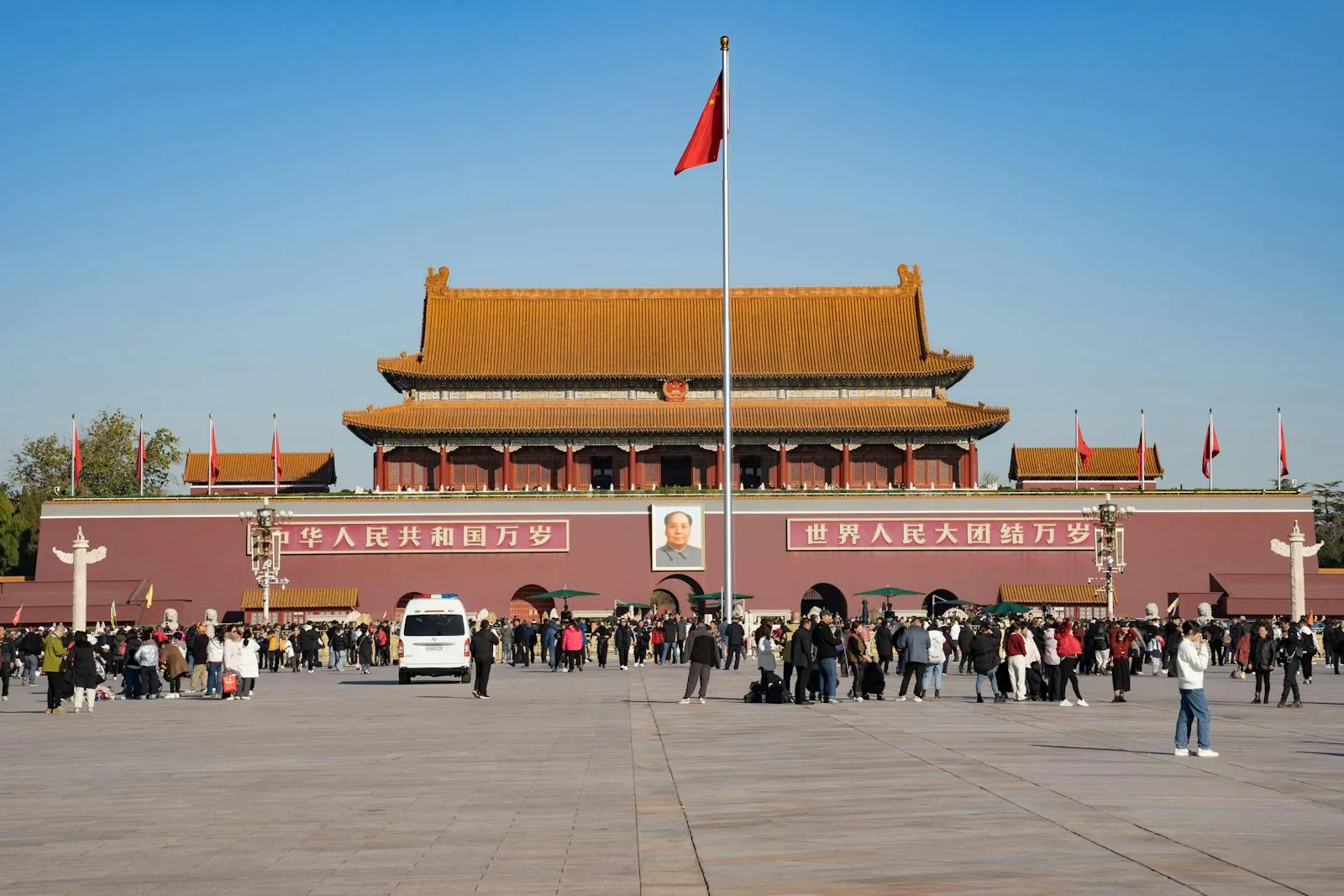
Trump and Xi Jinping sat together for more than five hours at the Great Hall of the People on Thursday, emerging in the late afternoon to sign a joint communiqué that ran to 28 points and roughly 3,200 words. More than three-quarters of that length covered trade, investment, and technology. The section on Taiwan covered one paragraph. The word “Hormuz” appeared once, in a subclause.
The document’s structure tells you as much as its contents. Seventeen months of trade and economic preparation — from the South Korea truce last November, through Scott Bessent’s two days of work in Seoul, through the individual negotiations that brought Jensen Huang and Tim Cook aboard Air Force One — produced language specific enough to bind both governments to a timeline. The questions that had no preparatory answer went into the communiqué the same way they went in: unresolved.
What the Communiqué Delivered
The commercial section of Thursday’s document confirmed what administration officials had flagged as the summit’s most achievable deliverables. Boeing’s commercial aviation agreement with China’s state-owned carriers — finalized at the bilateral session and announced by the White House in a separate fact sheet — covers the purchase of 130 737 Max 10 aircraft with options for 75 more, at estimated list-price value of roughly $44 billion. Actual prices on bulk commercial orders are typically discounted significantly below list. The order is the largest single aircraft purchase China has made from an American manufacturer in eleven years, structured for deliveries beginning in the third quarter of 2027, contingent on the FAA certification work already underway.
On agriculture, the communiqué locked in the soybean purchasing commitments from Bessent’s Seoul sessions — an annualized target through 2028 that restores roughly 80 percent of the pre-tariff-war purchasing levels Beijing maintained through 2016. On rare earths and critical minerals, China agreed to extend general export licenses for gallium, germanium, and rare earth materials through December 2026, preserving the suspension of controls that was a centerpiece of the November truce.
The tariff architecture received its most significant extension: both governments agreed to maintain the current reduced-tariff framework through November 2027, a one-year extension from the existing fall expiration. A formal renegotiation process will begin in the first quarter of next year. The language stops short of permanent normalization but removes the cliff-edge risk that had been a background anxiety for supply chains since the original truce.
Nvidia’s H200 deadlock — which the CEO delegation piece published Thursday morning identified as the summit’s central unresolved technology question — was handled in a dedicated section of the communiqué. Both governments commit to establishing a joint end-use verification framework for authorized semiconductor exports, with a pilot period of 12 months. Specific H200 shipment authorizations are not included. The arrangement is a framework for building the oversight architecture that would allow authorizations to proceed. Whether that registers as a win or a stall depends on where you sit: Jensen Huang’s statement Thursday evening described it as “a concrete path forward.” China’s Ministry of Industry and Information Technology called it “a constructive starting point.”
The Taiwan Paragraph
The communiqué’s Taiwan section runs to a single paragraph — Reuters counted 64 words — and reads as a deliberate return to pre-2024 diplomatic language. Both governments “reaffirm their commitment to the one-China policy as understood by each respective party.” The phrase “as understood by each respective party” is a specific and consequential qualifier. It allows Washington to maintain that its one-China policy — which acknowledges but does not endorse Beijing’s position on Taiwan — remains intact. It allows Beijing to characterize the statement as reaffirming its own formulation. Neither reading requires the other.
Absent from the communiqué: any mention of the frozen $14 billion Taiwan arms package currently held at the State Department. Any declaratory language on “opposing” Taiwan independence — the formulation Beijing had sought as a step beyond Washington’s longstanding “not supporting” position. Any reference to the Taiwan Relations Act.
The eight bipartisan senators who warned Trump before his departure not to trade away Taiwan’s security issued a statement Thursday afternoon. Six of the eight signed it; two released more muted separate remarks. The joint statement described the Taiwan paragraph as “insufficient” and called on the State Department to advance the frozen arms package within 60 days as a demonstration that the communiqué’s “as understood” qualifier meant what Washington claimed.
The arms package — Patriot interceptor missiles, surface-to-air systems, and anti-drone equipment — was approved by Congress under the Taiwan Relations Act. What has held it is executive discretion at the State Department, which has characterized the delay as a scheduling matter rather than a policy decision. Whether that characterization survives the summit’s Taiwan language is now the specific test the senators are pressing. The State Department had not responded to the senators’ statement by Thursday evening.
Iran: A Shared Concern and Not Much More
The Strait of Hormuz and the broader Iran conflict appear in the communiqué’s security section with language that both governments’ diplomatic teams would recognize as holding-pattern text. Both sides “expressed shared concern about the economic consequences of disruptions to global energy transit.” Both sides “expressed support for diplomatic resolution of the conflict consistent with international law.” The word “Hormuz” appears once, in a phrase calling for “freedom of navigation and maritime security in accordance with international law.”
What is not in the document: any Chinese commitment to communicate to Tehran that continued Hormuz disruption would affect bilateral oil purchasing. Any specific mechanism for Chinese participation in pressure on Iran. Any timeline or conditionality on Chinese energy imports from Iran.
The summit setup article published Wednesday evening noted that Beijing’s leverage over Tehran through oil purchases was the specific tool the U.S. team was seeking to activate at the summit table. That tool did not appear in Thursday’s communiqué. A senior administration official, speaking on background to Reuters, described the Iran outcome as “an ongoing conversation” that would continue in Friday’s working sessions and in diplomatic channels after the summit. That phrasing is the diplomatic equivalent of no progress — converted into language that does not admit it.
The operational significance of that gap is real. Saudi Aramco warned this week that oil markets may not normalize until mid-2027 if Hormuz remains disrupted at current levels. A Chinese commitment to pressure Tehran would have materially changed that calculus. Without it, the Iran track runs on the same timeline it ran before Air Force One crossed the Pacific.
What Friday Brings and What Comes After
Day two of the summit — working-level sessions on investment, aviation certification, financial market access, and energy — begins Friday morning at the Diaoyutai State Guesthouse. The sessions are expected to produce operational annexes that give the communiqué’s commercial commitments binding structure: specific delivery schedules for the Boeing order, licensing procedures for the rare-earth extension, and the technical design of the end-use verification pilot for semiconductors.
The Taiwan arms question will not be resolved at the summit table. What the senators’ statement has done is set a 60-day clock and framed the arms package as the specific test of whether Thursday’s communiqué means what Washington says it means.
The two deliverables that the summit’s coverage had identified as leading indicators — the Boeing order and the Taiwan language — produced results in opposite directions. The Boeing deal is done, specific, and large enough to generate domestic political cover for both leaders. The Taiwan language is precisely as ambiguous as the summit’s critics feared it might be, and the mechanism that would demonstrate its meaning — the arms package — now sits as an open action item at State.
The Iran outcome lands somewhere between those two: not the Chinese commitment that would have changed the strategic picture, but not a public breakdown of the diplomatic effort either. Both governments have enough in the trade sections to claim a win. Both have enough room in the security sections to claim the other conceded nothing. The most consequential questions — Taiwan’s defense guarantee, Iran’s access to Chinese markets — will outlast the summit table and land in the diplomatic channels that will be worked in the weeks after Trump’s departure Saturday morning.
Sources 6 cited · 3 primary
- Readout of President Trump's Bilateral Meeting With President Xi Jinping at the Great Hall of the People
- Xi Jinping Holds Talks With U.S. President Trump — Joint Communiqué of the People's Republic of China and the United States of America
- Fact Sheet: U.S.-China Beijing Summit Joint Communiqué — Trade and Technology Framework
- Trump and Xi Sign Joint Statement at Beijing Summit: Trade Deals Done, Taiwan Language Disputed
- Beijing Summit Communiqué Leaves Taiwan Language Ambiguous, Security Commitments Sparse
- Senators' Statement on the Beijing Summit Joint Communiqué
American Courant cites its sources and links to primary documents where they exist. How we report →