President Donald Trump departed Tuesday afternoon for Beijing, where he is scheduled to meet with Chinese President Xi Jinping beginning Thursday in what analysts describe as the most consequential U.S.-China summit in at least a decade. As Air Force One headed west, a $14 billion arms package for Taiwan sat untouched in the State Department — frozen for months by a White House that told agencies not to advance it ahead of the trip — and eight senators sent a public message that the administration should not read the delay as a mandate to go further.
The letter, sent Friday and led by Democratic Sen. Jeanne Shaheen of New Hampshire and Republican Sen. Thom Tillis of North Carolina, was addressed directly to Trump. “American support for Taiwan is not up for negotiation,” the signatories wrote. Six Democrats and two Republicans signed it — among them Sen. Tammy Duckworth of Illinois, Sen. Andy Kim of New Jersey, and Sen. John Curtis of Utah, who is also the chief Senate sponsor of the bill to codify Taiwan’s defense commitments into law. The letter urged Trump to formally notify Congress of the arms package and to resist treating Taiwan’s security as a bargaining chip for trade or economic concessions from Beijing.
Taiwan’s government has expressed the same anxiety in sharper terms. “What we are the most afraid,” Deputy Foreign Minister Francois Wu told Bloomberg last month, “is to put Taiwan on the menu of the talk between Xi Jinping and President Trump.”
The Frozen Package and the Timeline
The specific weapon sale that has stalled carries arms worth up to $14 billion, according to reporting from NPR and Bloomberg. At its core are interceptor missiles for Taiwan’s Patriot air-defense batteries — PAC-3 MSE rounds designed to engage ballistic missiles at high altitude — along with National Advanced Surface-to-Air Missile Systems, anti-drone equipment, and associated maintenance support. Senior lawmakers gave early approval to the package in January. The State Department has not moved it since.
The Patriot systems Taiwan currently deploys are older variants. The PAC-3 MSE interceptor, the latest production variant, has a higher reach and a faster engagement cycle than its predecessors; it is the specific type Taiwan’s defense planners have prioritized for years given the scale of China’s short- and medium-range ballistic missile inventory. An administration that genuinely intended to arm Taiwan for deterrence would have sent this package in January. The decision to hold it through months of diplomatic preparation for Beijing signals the opposite.
The Senate letter’s specific language — Taiwan’s military spending plan, recently approved by Taipei’s legislature, “removes any remaining rationale for delay” — was a deliberate counter to any administration argument that Taiwan’s own commitment to defense justified withholding the sale. The senators argued in plain terms that withholding it ahead of a summit with Beijing sends the wrong message about American reliability.
Trump confirmed before his departure that Taiwan arms sales are explicitly on the summit’s agenda, alongside the case of Jimmy Lai, the Hong Kong publisher held on national security charges in a Beijing-administered court. Publicly confirming both items as summit topics, rather than leaving them to quiet diplomatic channels, reflects a degree of political awareness that the Senate letter had arrived — and perhaps a hedge against the appearance of having traded Taiwan’s security without a visible fight.
Forty Years of Policy Under Scrutiny
The deepest concern in Taipei and among Taiwan’s advocates in Congress is not one arms package. It is the steady erosion of a framework built over four decades to insulate Taiwan’s defense relationship from Chinese pressure.
In 1982, the Reagan administration offered Taiwan a set of written assurances in exchange for Taipei’s acquiescence to the U.S.-China joint communiqué: the United States had not agreed to set a date for ending arms sales to Taiwan, had not agreed to consult with Beijing before making arms decisions, and would not play any mediation role between Taipei and the mainland. These Six Assurances functioned for 40 years as a floor under the relationship — not statutory law, but firm enough that no administration had visibly violated them.
That changed in February 2026. During a phone call between Trump and Xi, Xi raised concerns about U.S. arms sales to Taiwan and urged the administration to handle them with “utmost caution.” According to the Chinese government readout — the version Beijing chose to publish — Trump engaged on the subject. It was the first time since the assurances were issued that an American president had acknowledged consulting with Beijing on Taiwan arms sales. The call was not accompanied by any American readout that contradicted China’s account.
The congressional response was swift. Rep. Raja Krishnamoorthi, an Illinois Democrat, led a bipartisan group in reintroducing H.R. 3452, the Six Assurances to Taiwan Act. If enacted, the bill would codify the assurances as statutory U.S. policy and require the executive branch to notify Congress before taking any action that contradicts them, with a 60-day review window during which lawmakers could pass a joint resolution of disapproval to block it. The House Foreign Affairs Committee advanced the bill in September 2025; the Senate companion, S. 3208, was introduced by Curtis and Sen. Jeff Merkley of Oregon. Neither chamber has held a floor vote.
That gap between committee advancement and floor vote is the vulnerability. The assurances remain informal policy — powerful precedent, powerful enough that four administrations respected them — but not a legal constraint on the current one.
What Beijing Is Expected to Ask
Pre-summit analyses from the Council on Foreign Relations and other policy institutions describe Beijing’s Taiwan asks in concrete terms. The minimum ask is a change in American declaratory language: a shift from “not supporting” Taiwan independence to explicitly “opposing” it — a word that carries substantial legal and diplomatic weight in cross-strait relations. The larger ask is institutional: pre-consultation on arms sales to Taiwan, converting what the February phone call did informally into a formal process.
Either of those concessions would represent a larger policy change than any specific arms package delay. A declaratory shift, once made, is difficult to walk back without a diplomatic incident. Pre-consultation on arms sales — if Beijing can be said to have a veto, or even a formal venue for input — fundamentally changes the political cost of every future Taiwan sale for any administration.
The broader summit agenda also covers the Iran war and the trade truce expiring this fall. China has specific things it can offer Trump: preliminary terms for a large Boeing aircraft order, expanded agricultural purchasing, and continued rare earth supply under the truce framework that expires in November. Those economic deliverables give Beijing the capacity to bundle Taiwan concessions inside a package that looks primarily like a business deal — a structure that makes individual concessions harder to identify and harder to oppose in Congress.
Treasury Secretary Scott Bessent is conducting parallel trade talks with Chinese Vice Premier He Lifeng in Seoul this week, working to lock in economic commitments before Trump and Xi sit down. The economic dimension of the summit is real and consequential. The concern among Taiwan’s advocates is that the economic dimension becomes cover for security concessions that are harder to see from the outside.
What Comes Next
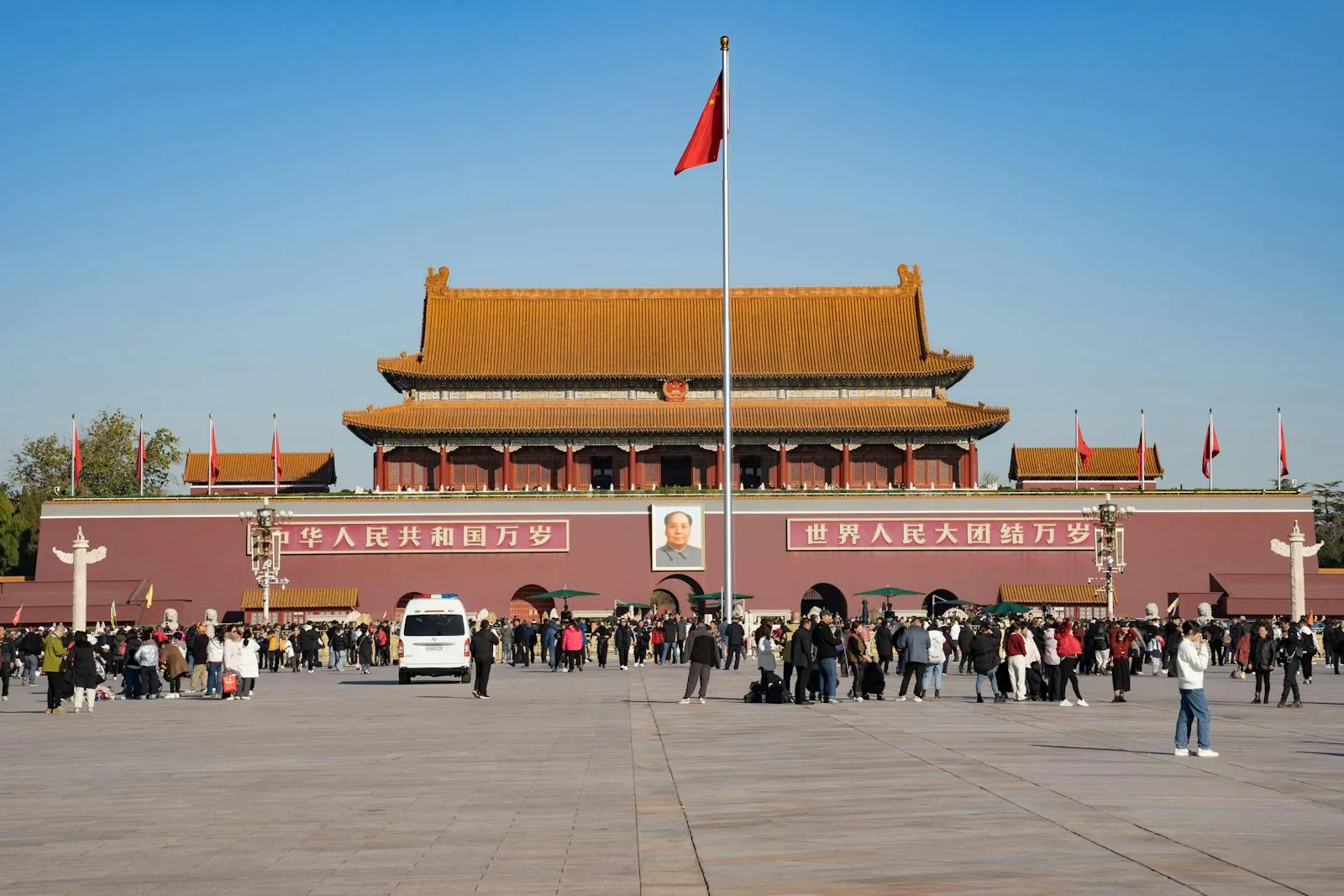
The bilateral sessions are scheduled for Thursday and Friday at the Great Hall of the People. A state banquet follows Thursday evening. The two governments have not pre-announced specific deliverables, and neither has confirmed whether a joint statement will be issued when the summit closes May 15. Whether that statement contains any language on Taiwan — and if so, what it says — is the specific variable Taipei’s government and the Senate signatories are watching.
The Iran war is the summit’s other weight-bearing issue. If Trump emerges from Beijing with a credible Chinese commitment to pressure Tehran toward a ceasefire, he will face pressure to show what he gave in exchange. China is Iran’s largest oil buyer; cutting those purchases, or publicly endorsing U.S. pressure on Tehran, represents a genuine cost for Beijing. The oil market’s anxiety about a potential 2027 normalization timeline gives Trump strong domestic incentive to reach a Hormuz deal, which in turn gives Xi leverage to ask for something Beijing cares about — and Taiwan is at the top of that list.
Congress has one more check available if the summit produces policy changes on Taiwan. The legislation pending in both chambers provides a vehicle for a response, and the eight senators who signed Friday’s letter have established their position on the record before any concession is made. The $14 billion arms package is the concrete test case: its fate in the weeks after Beijing will indicate whether the administration’s Taiwan policy shifted at the summit table or held.
Sources 6 cited · 3 primary
- Senators Urge Trump to Advance $14 Billion Taiwan Arms Sale Before Xi Summit
- As Trump Plans Visit to China, Arms Package to Taiwan Is Delayed
- Trump Puts Taiwan Arms Sales, Hong Kong Jailed Activist Lai on Agenda Ahead of Meeting With Xi
- Taiwan Fears It'll Be 'On the Menu' at Trump-Xi Summit
- H.R.3452 - Six Assurances to Taiwan Act
- At the Trump-Xi Summit, China Will Have the Upper Hand
American Courant cites its sources and links to primary documents where they exist. How we report →