When Air Force One rolled to a stop at Beijing Capital International Airport Wednesday evening local time, the delegation that descended the stairs read like an index of every unresolved U.S.-China technology dispute. Elon Musk and Tim Cook had been on the roster for weeks. Jensen Huang had not.
The Nvidia chief executive — whose company makes the AI accelerator chips that China most urgently wants and that Washington has most carefully restricted — was not included when the White House released its official delegation list last week. Then media outlets noted his absence. President Donald Trump called Huang personally on Tuesday. By Wednesday morning, Huang had boarded Air Force One at the Alaskan refueling stop. His presence had already reshaped the summit’s narrative before the plane crossed the Pacific.
That last-minute reversal makes the delegation’s composition not just notable but diagnostic. A president who wants to arrive in Beijing with a headline technology deal does not put the world’s most sought-after chipmaker on Air Force One to say no. Whatever gets announced Thursday when Trump and Xi Jinping hold their first formal bilateral at the Great Hall of the People, Nvidia’s H200 deadlock will be somewhere on the agenda.
The Delegation and What Each Seat Signals
Trump has long blended diplomatic and commercial objectives on foreign trips, but the Beijing roster is unusually concentrated around a single theme: every major executive in the delegation has a specific, unresolved technology or market-access dispute with China.
Elon Musk leads Tesla, whose Shanghai Gigafactory produces more than 700,000 vehicles annually — roughly half of the company’s global output. The plant’s full operation depends on stable access to Chinese suppliers and continued low tariff treatment of components moving across the supply chain. Musk’s dual role — as a commercial figure with enormous China exposure and as a prominent Trump administration insider through DOGE — gives him an unusual seat at the bilateral table.
Tim Cook represents Apple, which despite years of supply chain diversification still manufactures the overwhelming majority of its hardware through Foxconn and Pegatron facilities in China. Earlier this year Cook committed Apple to a $600 billion U.S. investment plan — a move that helped secure import tariff exemptions on iPhones and iPads at a moment when tariffs on Chinese-assembled goods were threatening device prices. His Beijing presence signals Apple’s interest in protecting those exemptions and the manufacturing arrangements underlying them.
Larry Fink chairs BlackRock, which entered mainland China’s mutual fund market in 2021 and has been navigating the licensing regime for foreign financial firms since. A durable trade stabilization would improve the operating environment for foreign asset managers seeking domestic scale in China’s retail investment market. Fink’s seat at the table points toward the capital-market access component of the broader trade framework.
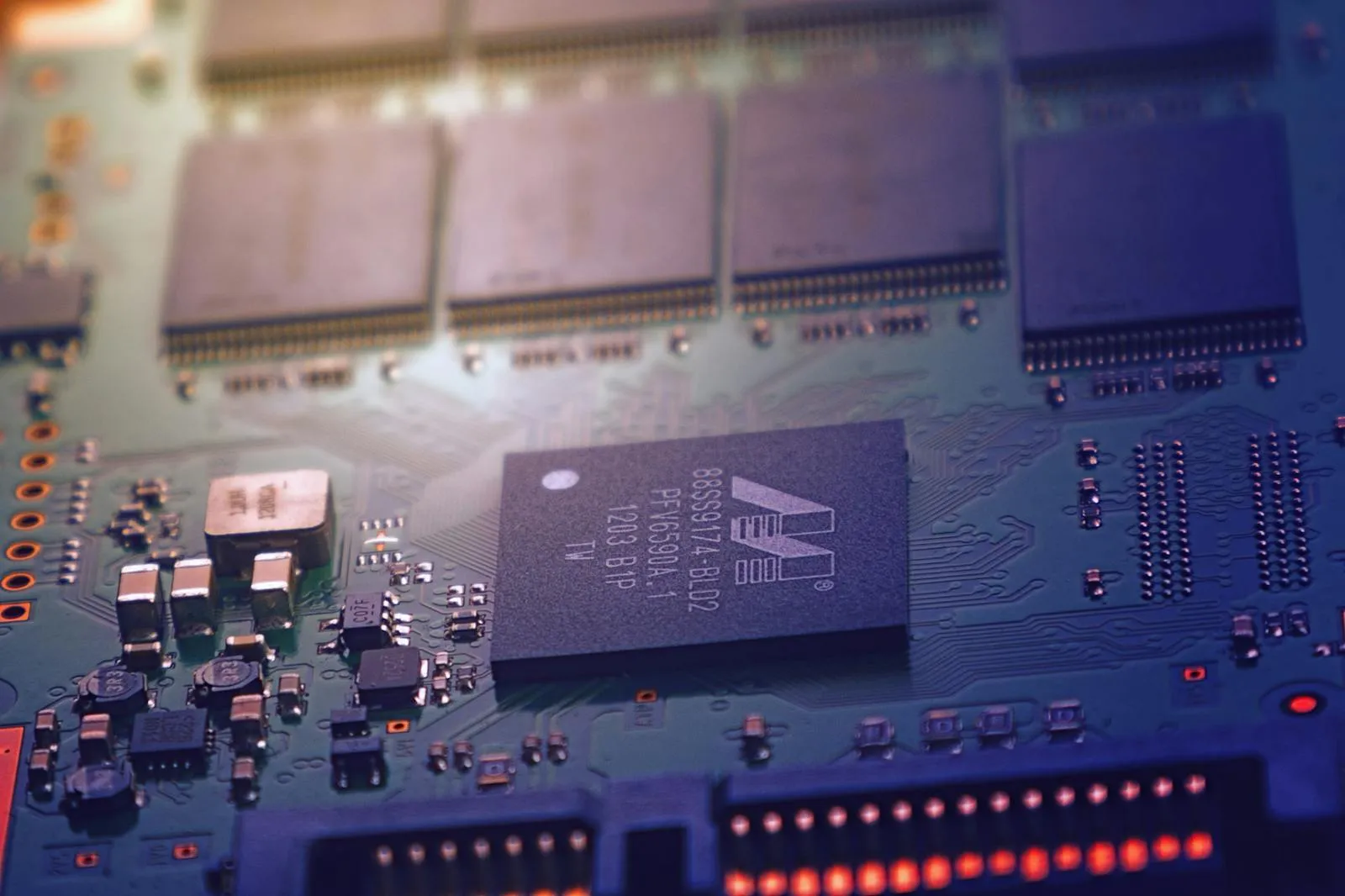
Jensen Huang sits at the most acute intersection of the U.S.-China dispute. Nvidia’s H200 chips — the intermediate-tier accelerators the Trump administration authorized for China sale late last year — have not shipped a single unit to any Chinese customer. The deadlock is structural: Washington’s export license requires ongoing access to verify the chips are not redirected to military use, a condition that Chinese buyers and the Chinese government have rejected as incompatible with domestic data security law. Both sides are technically in compliance with their own positions. The chips stay in warehouses.
The H200 Question and Why the Deadlock Has to Break
The chip dispute is not just about Nvidia’s quarterly earnings. China’s AI sector — including Alibaba, Baidu, Tencent, and the newer DeepSeek — has been advancing at significant speed despite hardware constraints, partly by training on older-generation chips and partly by developing novel architectures that require less raw compute than U.S. models. But the absence of current-generation accelerators is a genuine bottleneck for the most compute-intensive training runs.
For Washington, the calculus has shifted. If China’s AI sector can advance meaningfully with second-tier hardware while the United States excludes American companies from the market, then the ban achieves strategic separation on paper but not in practice — while mainly reducing U.S. revenue and goodwill. Some voices within the administration have argued that a controlled sale with real verification is a better outcome than a blocked sale with nominal authorization. Huang’s last-minute boarding suggests that argument has reached the president.
The summit’s technology agenda is not limited to chips. Both governments have identified artificial intelligence governance, export controls, and commercial AI product development as agenda items. China has sought a formal bilateral AI dialogue mechanism, while Washington has been cautious about structures that could provide diplomatic cover for technology transfers it has otherwise restricted. A Huang-brokered chip deal and a formal AI dialogue framework could emerge Thursday as a paired announcement.
Beijing’s First Characterization
Chinese state broadcaster CCTV, in its readout of the arrival-day contacts between delegations, described “candid, in-depth, and constructive exchanges on resolving economic and trade issues of mutual concern and further expanding practical cooperation.” That phrasing is a recognizable diplomatic register: “candid” typically signals genuine disagreement was aired, “constructive” signals neither side walked out, and “practical cooperation” is the placeholder for deliverables both sides are prepared to claim as wins.
The phrase conspicuously absent: any language suggesting strategic alignment or shared values. Beijing has consistently avoided formulations that might be read domestically as endorsing Trump’s political brand, or that would allow U.S. media to characterize the summit as a Chinese concession to Trump’s style of dealmaking.
The working-level trade deliverables that analysts have identified as most achievable — agricultural purchasing commitments, Boeing commercial aircraft orders — center on goods trade that both governments have incentives to announce as concrete results. Those deals had been largely sketched in advance. As American Courant reported Wednesday, Treasury Secretary Scott Bessent’s two days of preparatory talks in Seoul established the economic floor for Thursday’s session, covering goods trade without resolving the harder technology questions now on Huang’s table.
Thursday’s Formal Agenda and the Fault Lines That Remain
The formal bilateral Thursday morning is structured as a Trump-Xi one-on-one before the full delegations convene. That sequencing matters: the sensitive topics — Taiwan arms sales, Iran, chip verification terms — will be addressed in the smaller room. The commercial deliverables come when the full delegation enters.
On Iran, Trump has signaled he wants Xi to apply China’s economic leverage with Tehran toward reopening the Strait of Hormuz and reaching a peace agreement. That is a significant ask. The Strait of Hormuz closure has already prompted Aramco’s CEO to warn of supply disruption lasting into 2027. China is Iran’s largest oil buyer and has provided crucial sanction-insulation throughout the U.S. military campaign against Iranian nuclear and naval assets. Xi has incentives to see the conflict resolved — oil price volatility imposes real costs on the Chinese economy — but not at the cost of publicly delivering Iranian concessions to Washington.
On Taiwan, the question that eight bipartisan senators publicly flagged before Trump’s departure is whether the frozen $14 billion arms package becomes a bargaining chip in exchange for Chinese cooperation on Iran or chip verification. Trump stated this week he would “discuss” arms sales with Xi — a break from longstanding U.S. policy of treating Taiwan arms sales as non-negotiable with Beijing. Taiwan’s government is watching closely for any shift in the language the United States uses to describe the cross-strait relationship, particularly any formulation that could be read as endorsing “peaceful unification.”
A joint communiqué is not expected. When the bilateral concludes, the United States and China will issue separate readouts. They will not be identical. The divergence, if any, will be in how each side characterizes what was said about Taiwan.
Beijing built the Temple of Heaven for Chinese emperors to communicate with heaven. Trump’s scheduled Thursday evening tour of the site is ceremonial protocol. The deals — or the shape of their absence — come from the morning session.
Sources 6 cited · 1 primary
- Readout of President Trump's Arrival in Beijing and Initial Meetings With Chinese Officials
- Trump in China: President lands in Beijing with Tesla, Nvidia CEOs
- Nvidia CEO Huang Joins Trump's China Visit as Last-Minute Addition
- CEOs join Trump in China as AI takes priority over trade deals
- Trump invites Elon Musk, Tim Cook, Larry Fink and other CEOs to join China trip for Xi summit
- China's Xi expected to press Trump on Taiwan, tariffs during summit
American Courant cites its sources and links to primary documents where they exist. How we report →