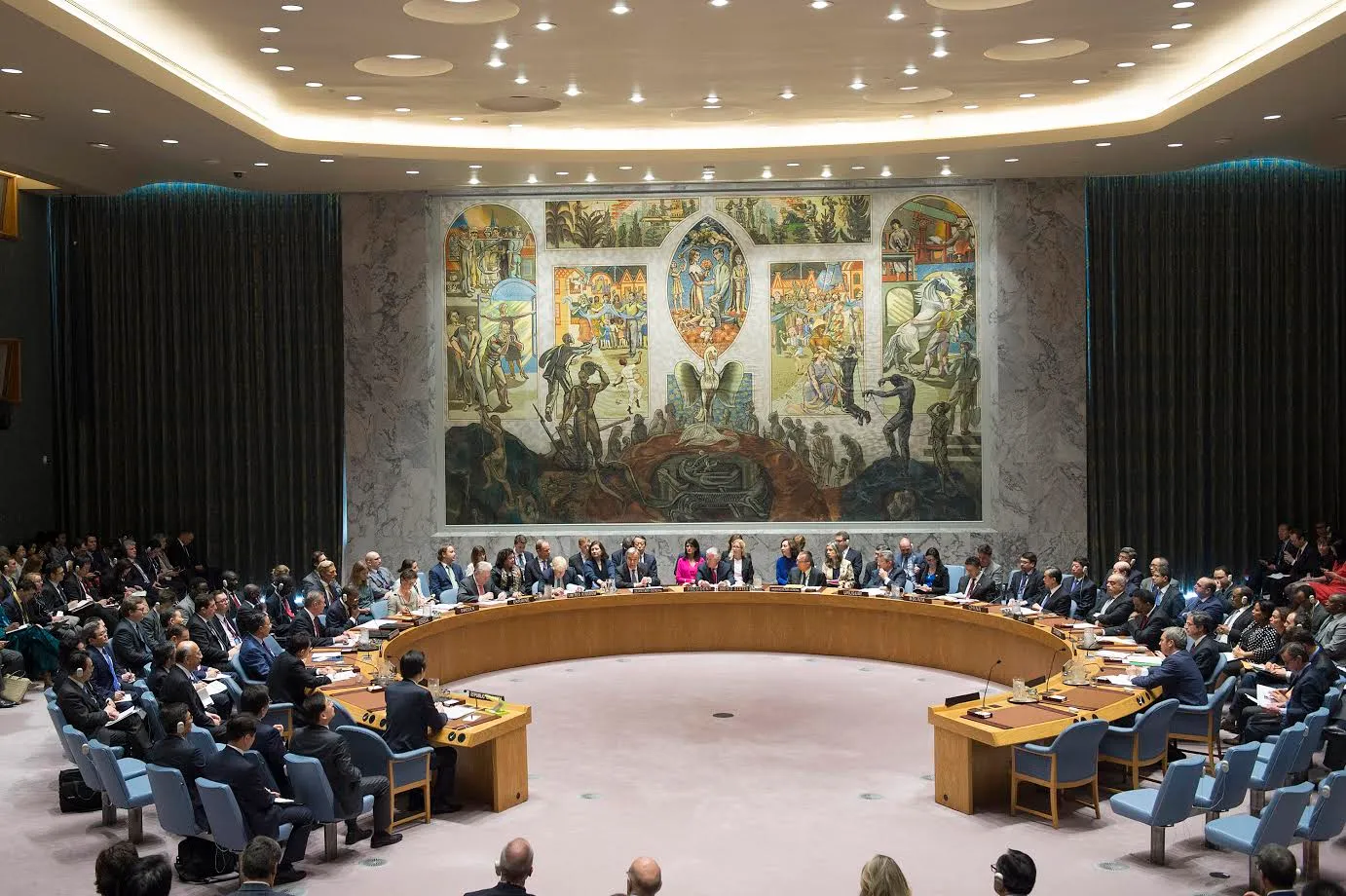
The United Nations Security Council, a body that has spent years deadlocked on almost everything from Ukraine to Gaza, found something this week that all 15 of its members could endorse without a single objection: a demand that Afghanistan’s Taliban rulers stop their crackdown on women and girls.
The Council voted unanimously to adopt Resolution 2822 (2026), renewing the mandate of the United Nations Assistance Mission in Afghanistan, known as UNAMA, until 17 June 2027. The text — drafted by China and backed by the United States, Russia and every other member — keeps the U.N.’s political presence in the country alive for another year and uses that renewal to put the entire Council on record against the Taliban’s treatment of half the population. The vote came days after Taliban forces opened fire on protesters in the western city of Herat.
A rare 15-0 vote
Unanimity on the Security Council is unusual on any contested file, and Afghanistan has been among the most contested since the Taliban seized power in 2021. That the resolution passed 15-0 — with China holding the pen and Russia voting yes alongside Washington — is itself the news. The Council does not often speak with one voice, and when it does, the choice of words carries weight that individual governments’ statements do not.
The resolution calls on the Taliban to “swiftly reverse” the restrictions they have imposed on women and girls, to combat militant groups operating inside Afghanistan, to meet their counterterrorism commitments, to respect the country’s international obligations and to end what diplomats describe as hostage diplomacy. It also asks the U.N. secretary-general to conduct a strategic review of the mission and report back by the end of March 2027 — a signal that the Council intends to reassess what UNAMA can still accomplish under a government that has steadily narrowed the space in which it operates.
That narrowing is concrete. The Taliban have barred Afghan women employed by the United Nations from entering U.N. premises, a restriction the resolution singles out as an obstacle to UNAMA’s ability to function at all. Since 2021 the authorities have closed secondary schools and universities to girls and young women, pushed women out of most paid work and public life, and enforced dress and movement rules through a morality police.
What happened in Herat
The vote landed against a fresh and violent backdrop. According to accounts presented to the Council, the Taliban’s so-called morality police arbitrarily detained dozens of women and girls in Herat in early June over their “appearance and dress.” A rare public protest followed, and Taliban forces dispersed it with live fire, killing at least one person and wounding several others.
The shooting gave the resolution its urgency and, diplomats indicated, helped concentrate a fractious Council. It is one thing to debate the abstract trajectory of women’s rights under Taliban rule; it is another to vote in the immediate aftermath of security forces firing on demonstrators. The Council’s unanimous language was, in part, a response to that.
Four years of tightening restrictions
The Herat episode fits a pattern that has hardened steadily since the Taliban returned to power in August 2021. In the years since, the authorities barred girls from secondary school, then closed universities to women, then pushed women out of most non-governmental and aid work — a series of edicts that, taken together, has removed women and girls from education, most paid employment and large parts of public life. A “vice and virtue” framework enforced by morality police governs dress and movement, and women are generally required to travel with a male guardian.
The cumulative effect is what U.N. officials and human-rights bodies have described as a system without precedent in its scope. It is also what makes UNAMA’s continued presence contested: the same government the mission is meant to engage has restricted the mission’s own female staff, leaving the Council to weigh whether a diminished UNAMA still does more good inside the country than a withdrawal would. The strategic review the resolution orders is, in effect, an acknowledgment that the answer is no longer obvious.
UNAMA itself is not a peacekeeping force. It has no troops and no enforcement power; its mandate is political and humanitarian — coordinating aid, monitoring human rights, and maintaining a channel between the Taliban administration and the outside world. Renewing it keeps that channel open for another year, which supporters argue is preferable to going dark in a country where tens of millions depend on humanitarian assistance.
Where Washington fits
The United States is one of the five permanent members that drafting and adopting a resolution requires, and it used its explanation of vote to sharpen the message. U.S. deputy ambassador Jennifer Locetta said the Taliban must meet their counterterrorism commitments, respect Afghanistan’s international obligations, end hostage diplomacy and cease their “unconscionable abuses of the human rights of women and girls.”
Each of those demands maps to a concrete American interest. Counterterrorism commitments speak to the worry that Afghan territory could again host groups capable of attacks beyond the region — the same concern that animates the administration’s broader counterterrorism posture. The reference to hostage diplomacy points to detained foreign nationals, Americans among them, whom the Taliban have used as leverage. And the human-rights language aligns the United States with a position China itself chose to put on paper, a notable convergence for two governments that met for a high-stakes summit earlier this year and disagree on most everything else.
What the resolution can and cannot do
A Security Council resolution does not, by itself, change conditions on the ground in Kabul or Herat. The Taliban are not a U.N. member government, have shown little deference to the body’s demands, and have already restricted the very mission the Council just renewed. The resolution carries no new sanctions and no enforcement mechanism; its power is diplomatic and reputational.
What it does accomplish is to deny the Taliban the argument that the world is divided over their conduct. When the United States, China, Russia and a dozen other governments with sharply different agendas all sign the same demand, the Taliban cannot credibly cast criticism of their treatment of women as a Western talking point. The strategic review due by March will test whether that unity translates into any leverage — or whether UNAMA’s renewed year mainly documents a crackdown the Council can condemn but not stop.
For now, the vote stands as a marker. The Security Council reached for the lowest bar it could clear together and cleared it: that the shooting of protesters in Herat, and the system of restrictions behind it, was something all 15 members were willing to put their names against.
Sources 5 cited · 2 primary
- Security Council Renews Mandate of United Nations Assistance Mission in Afghanistan, Unanimously Adopting Resolution 2822 (2026)
- Explanation of Vote Following the Adoption of a UN Security Council Resolution Renewing the Mandate of UNAMA
- UN calls on Afghanistan's Taliban rulers to reverse crackdown on women
- U.N. calls on Afghanistan's Taliban rulers to reverse crackdown on women
- UNSC calls on Afghanistan's Taliban rulers to reverse crackdown on women
American Courant cites its sources and links to primary documents where they exist. How we report →