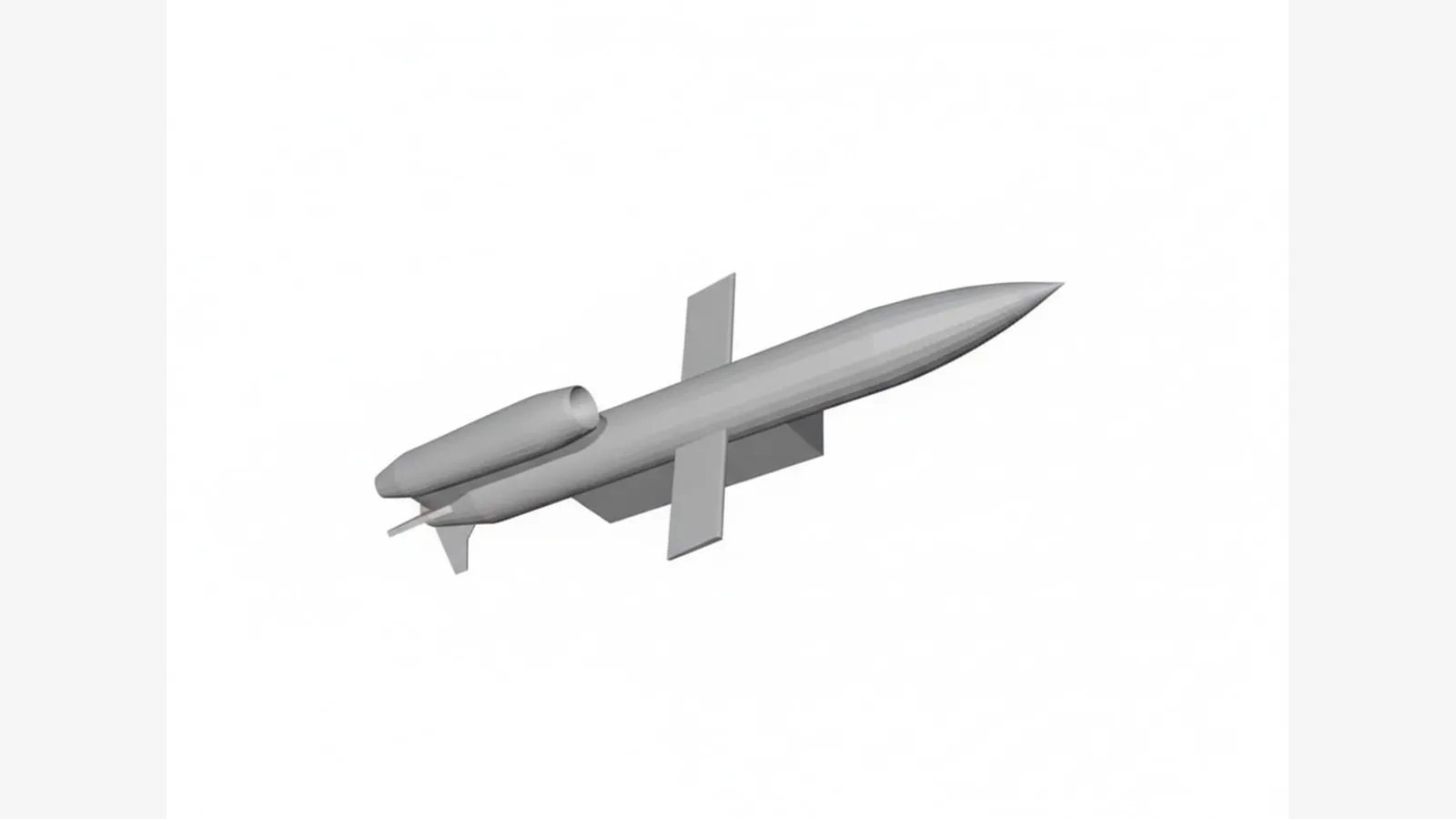
Overnight on May 4–5, Ukraine launched an FP-5 “Flamingo” cruise missile at a defense electronics plant in Cheboksary, roughly 1,000 kilometers from the Ukrainian border. The missiles traveled more than 1,500 kilometers in total to reach multiple targets. President Volodymyr Zelensky confirmed the strike on Telegram, posting video of the launches and describing it as part of Ukraine’s ongoing “Deep Strike” campaign against Russian military-industrial infrastructure.
The plant that burned is JSC VNIIR-Progress, a defense electronics manufacturer in Russia’s Chuvash Republic. It makes GNSS receivers and antennas — specifically the Kometa-type guidance modules integrated into Shahed-type kamikaze drones, Iskander-M ballistic missiles, Kalibr cruise missiles, and UMPK guided bomb kits. Hitting it doesn’t just damage a factory. It disrupts a supply chain that runs through nearly every precision weapon Russia is currently using.
“Ukraine’s long-range capabilities will continue to be used against military targets,” Zelensky said in his post, while calling on Russia to pursue “real diplomacy.”
What the Flamingo is, and why its range matters
The FP-5 Flamingo is not a Western-supplied weapon. It was developed by Fire Point, a private Ukrainian defense company, and first revealed publicly in August 2025 when an Associated Press photographer documented a test launch at a hidden facility in southern Ukraine.
The missile is large. It carries a wingspan of about six meters, a launch weight of around 6,000 kilograms, and a warhead of 1,150 kilograms. That’s heavier than many aircraft bombs. It cruises at subsonic speeds between 850 and 900 kilometers per hour, powered by a turbojet engine, and navigates via GPS-assisted inertial guidance. The stated maximum range is 3,000 kilometers, which, if accurate, puts every population center in Russia reachable from Ukrainian territory.
The strategic logic is straightforward. Ukraine cannot wait for Western governments to release long-range strike authorizations. A domestically built missile with 3,000-kilometer range bypasses that approval chain entirely. Fire Point claimed in March to be manufacturing three Flamingos per day, a production cadence that, if accurate, could sustain a consistent deep-strike campaign.
The Cheboksary strike fits a pattern of escalating deep penetrations. On February 20, Flamingo missiles hit the Votkinsk Machine Building Plant, which assembles Iskander and Topol ballistic missiles, more than 1,400 kilometers from the border. On March 28, the missiles destroyed an explosives plant in Chapaevsk, Samara Oblast. On February 8, Ukraine claimed a hit on the Kapustin Yar test range using the same weapon. This is, by distance, the deepest confirmed use of the Flamingo to date in this particular target set.
The plant and what it builds
VNIIR-Progress is not a household name, but its components show up in Ukrainian battlefield forensics constantly. Engineers analyzing recovered Shahed drones have repeatedly documented Kometa-series antennas in the guidance packages. The same modules appear in Iskander wreckage recovered from strike sites.
The plant sits in Cheboksary, the capital of the Chuvash Republic, a Russian federal subject roughly due east of Moscow. It’s not a logistics hub or a supply depot. It’s an engineering facility with a specific and difficult-to-replace production process. Antenna and GNSS module manufacturing requires precision fabrication and calibration capabilities that can’t be spun up quickly in a substitute location.
Ukraine’s General Staff said in a statement following the strike that the facility had been reinforced with anti-drone defenses after earlier attacks. The Flamingo, as a cruise missile rather than a drone, presents a different interception challenge: it flies faster and carries a warhead that causes catastrophic structural damage on impact rather than the lighter explosive payloads of kamikaze drones.
The overnight operation was not limited to Cheboksary. Ukraine also struck the Kirishisky oil refinery in Leningrad Oblast and conducted a mass drone attack involving roughly 289 unmanned aircraft across multiple Russian regions.
Why this matters now
The Cheboksary strike comes at a diplomatically sensitive moment. Putin has proposed a 48-hour ceasefire tied to Russia’s Victory Day celebrations on May 9, while Ukraine announced its own ceasefire declaration set to begin the night of May 5–6. The competing announcements frame Russia as the aggressor if fighting continues. Zelensky’s confirmation of the Flamingo strike and his simultaneous call for “real diplomacy” are part of the same message: Ukraine can negotiate from a position of demonstrated capability, or Russia can absorb more of this.
The attack on a guidance components factory also fits into a broader Ukrainian targeting strategy. Rather than focusing exclusively on energy infrastructure, the approach that dominated strike packages through much of 2025, Ukraine has increasingly prioritized the plants that feed Russian precision weapons production. Compare it to the way Iran’s strikes against the UAE’s Fujairah oil zone this week targeted a chokepoint in global energy supply: Ukraine’s deep-strike campaign targets a different kind of chokepoint, the precision guidance components that turn unguided munitions into weapons that can hit apartment buildings or power stations from 70 kilometers away.
If VNIIR-Progress stays offline, the downstream effect is a slower replenishment rate for Shahed guidance kits and Iskander warhead packages. That doesn’t stop Russian missile strikes immediately, but it erodes the stockpile over weeks and months.
Background: Ukraine’s domestic missile program
Before the Flamingo, Ukraine’s longest-range domestically produced strike capability was the R-360 Neptune, an anti-ship missile that famously sank the Russian Black Sea Fleet flagship Moskva in April 2022. The Neptune was adapted for land targets, but its range was limited. Western-supplied ATACMS extended Ukraine’s reach to about 300 kilometers when the United States eventually authorized their use, and British Storm Shadow and French SCALP cruise missiles pushed that to around 550 kilometers.
The Flamingo changes the arithmetic. At 3,000 kilometers of stated range and with production now running at a claimed three missiles per day, Ukraine has, for the first time, a domestically manufactured weapon capable of hitting any point in Russia, including cities that have watched the war from a safe distance for three years.
The EU’s $106 billion war loan for Ukraine provides the economic backing that keeps this defense industrial base funded. European governments have also moved faster than the United States in releasing strike authorizations for their own supplied systems.
The next question for analysts is whether Russia can reconstitute VNIIR-Progress’s production capacity, and how quickly. The facility has been struck before. Ukrainian sources report previous hits in the summer and November of 2025, and production resumed after both. The Flamingo strike represents a larger warhead and a more structurally damaging hit than the earlier drone attacks. The extent of the damage will not be independently verifiable for days.
What comes next
Zelensky’s message was brief but pointed. Ukraine’s long-range capability exists, it works, and he wants Russia to engage in real peace talks. That framing sets up a test for the competing ceasefire declarations: if fighting continues through the Victory Day weekend, Ukraine will say it honored its own truce and Russia refused. If Russia holds fire, Ukraine will claim the deep-strike pressure is what worked.
For the Russian weapons supply chain, the Cheboksary hit is one node among many, but it’s a node that doesn’t have a clear substitute. The precision guidance components VNIIR-Progress manufactures aren’t made in volume anywhere else in Russia’s defense industrial footprint. Replacing that capacity takes time, supply, and skilled manufacturing infrastructure that the Russian economy, under sanctions tightened throughout the Iran war period, is increasingly strained to provide.
Ukraine’s Deep Strike campaign isn’t a single attack. It’s an attrition strategy aimed at a specific input, the high-precision components that make Russian missiles dangerous. Last night’s strike is the latest data point in that campaign.
Sources 6 cited · 2 primary
- Zelensky Confirms Flamingo Missile Use in Deep Strike on Russian Military Plant, Shares Video of Strike
- Defense Forces struck the VNIIR-Progress plant and an oil refinery in Russia — General Staff of the AFU
- Ukraine strikes Russian Shahed, Iskander component facility, major oil refinery amid large-scale attack
- Ukraine Strikes Defense Electronics Plant 1,000 km Inside Russia Using Flamingo Cruise Missile
- FP-5 Flamingo
- Where is Flamingo? Analysis of all known attacks using Ukrainian FP-5 missiles
American Courant cites its sources and links to primary documents where they exist. How we report →