Venezuela’s acting president, Delcy Rodríguez, has been the subject of a detailed U.S. Drug Enforcement Administration intelligence file since at least 2018. In 2022, the DEA labeled her a “priority target” — a designation the agency reserves for suspects it believes have a “significant impact” on the drug trade. Her name has surfaced in nearly a dozen DEA investigations across field offices from Paraguay and Ecuador to Phoenix and New York.
In May 2026, the Associated Press reported that the Trump administration quietly instructed federal prosecutors in Miami to avoid pursuing any criminal investigations involving Rodríguez. One former U.S. law enforcement official told the AP bluntly: “Everybody has been told to stand down.” The Justice Department pushed back with a categorical denial. A DOJ spokesperson said in an email that “there was never an investigation into her to shut down.”
The unresolved factual question at the center of this story: whether senior Trump administration officials directed law enforcement to halt active federal scrutiny of Venezuela’s acting president as a condition of the diplomatic realignment that followed Maduro’s capture — or whether, as the DOJ maintains, no such federal investigation was ever formally opened and the AP’s sources are describing intelligence activity that never rose to the level of a prosecutorial case.
What Is Confirmed
The DEA had amassed a detailed intelligence file on Rodríguez dating to at least 2018, cataloging her known associates and allegations ranging from drug trafficking to gold smuggling. In 2022, the agency gave her its “priority target” designation, which the DEA uses specifically for suspects believed to have a “significant impact” on the drug trade, according to DEA records obtained by the Associated Press.
The scope of that file was substantial. Her name appeared in nearly a dozen DEA investigations across multiple field offices — a geographic spread that included offices in Paraguay, Ecuador, Phoenix, and New York. Several of those investigations remained active as recently as early 2026, according to the AP’s reporting. In early 2021, a confidential informant told DEA investigators that Rodríguez was using hotels at the Venezuelan Caribbean resort of Isla Margarita “as a front to launder money.” She had also been linked to Alex Saab, who U.S. authorities describe as Maduro’s financial intermediary and whom federal prosecutors arrested in 2020 on money-laundering charges.
Rodríguez herself has never been publicly charged with any crime in the United States. The DEA intelligence file and the investigations in which her name appeared did not result in a public indictment or criminal referral.
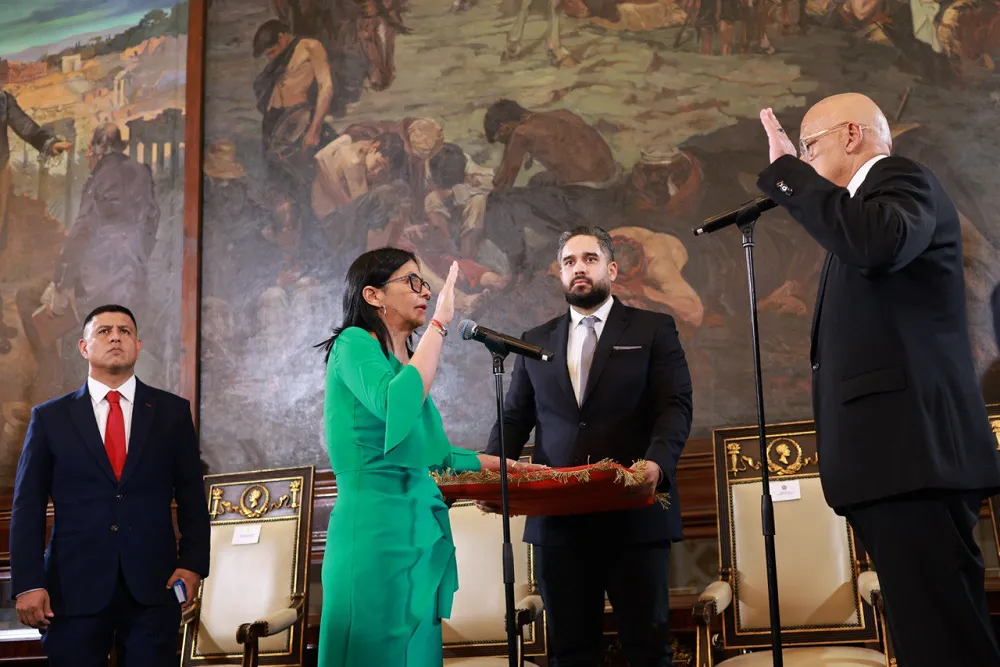
On January 3, 2026, U.S. military forces captured Venezuelan President Nicolás Maduro in Caracas. The capture of Maduro drew intense attention to prediction-market activity, including a federal case against a U.S. Army special forces soldier who investigators say placed bets on the raid using classified information. Two days after Maduro’s capture, on January 5, Venezuela’s Supreme Court ordered Rodríguez — who had served as Maduro’s vice president since 2018 — to assume the powers and duties of acting president.
Trump praised Rodríguez publicly after the transition, calling her a “terrific person.” The administration’s posture toward her shifted rapidly from the adversarial stance of previous sanctions regimes. On April 1–2, 2026, the U.S. Treasury’s Office of Foreign Assets Control formally lifted sanctions against Rodríguez — sanctions that had been imposed on her and her brother Jorge Rodríguez during Trump’s first term for their alleged role in undermining Venezuelan democracy. The administration recognized her as Venezuela’s sole head of state and U.S. officials began working with her government on a phased plan to open Venezuela to private capital and international arbitration.
The AP published its stand-down report on May 27–28, 2026. The AP subsequently published a clarification of the story.
Where the Accounts Diverge
The central dispute is a factual contradiction that cannot be resolved by splitting the difference.
The AP’s sources — described as multiple current and former U.S. law enforcement officials with direct knowledge — say the Trump administration issued a directive to Miami-based federal prosecutors to stop pursuing criminal investigations into Rodríguez. One former official used unambiguous language: “Everybody has been told to stand down.” The reported rationale was to avoid upsetting the administration’s stabilization effort in Venezuela following Maduro’s capture, and to smooth the path for U.S. investors seeking access to Venezuela’s petroleum reserves — the largest in the world.
The DOJ’s position is that this account is not merely mistaken but factually impossible: “There was never an investigation into her to shut down.” This is not a “we don’t comment on ongoing investigations” response — it is a categorical denial of the premise. The DOJ is saying there was no active federal criminal investigation of Rodríguez that could have been stopped.
A secondary tension runs beneath that central dispute. The DEA documents obtained by the AP show a sustained, multi-year intelligence effort with Rodríguez as a named target — including a “priority target” designation that is not assigned to incidental or peripheral figures. AML Intelligence, a specialized anti-money-laundering publication, reported as recently as March 2026 that the U.S. was actively building a money laundering case against Rodríguez. The DOJ denial does not directly address the DEA intelligence activity; it focuses specifically on whether a prosecutorial investigation — formally involving prosecutors — was opened.
That semantic distinction may be meaningful or may be a careful evasion, depending on which account is closer to the truth. A DEA intelligence operation can run for years without prosecutors in a U.S. attorney’s office opening a formal case file. Saying “there was never an investigation” could be technically accurate about the prosecutorial phase while being silent about everything that preceded it.
Trump’s May 2026 counterterrorism strategy designated drug cartels as the highest U.S. national security priority — a significant rhetorical escalation on narcotics enforcement. The administration has simultaneously pursued aggressive prosecutorial action against other Latin American officials on narcotics charges: the DOJ indicted Mexico’s Sinaloa state governor on drug trafficking allegations in April 2026, alleging cartel involvement in his 2021 election. Whether that same posture applies to Venezuela’s acting president, whose government controls access to the world’s largest petroleum reserves, is a question the administration has not addressed publicly.
The Timeline
2018: The DEA begins accumulating an intelligence file on Rodríguez, cataloging allegations of drug trafficking and gold smuggling and mapping her associates.
2020: Alex Saab, described by U.S. prosecutors as Maduro’s primary financial intermediary and money-laundering operator, is arrested by U.S. authorities on money-laundering charges. Rodríguez’s alleged ties to Saab become part of the DEA’s documentation.
Early 2021: A DEA confidential informant alleges that Rodríguez was using hotels at the Caribbean resort of Isla Margarita, Venezuela, “as a front to launder money.”
2022: The DEA formally designates Rodríguez a “priority target.” The designation signals that agency leadership believes she has a significant impact on narcotics trafficking.
January 3, 2026: U.S. military forces capture Nicolás Maduro in Caracas. Maduro is transported to New York to face federal drug-trafficking and weapons charges.
January 5, 2026: Venezuela’s Supreme Court orders Rodríguez to exercise presidential powers. She is sworn in as acting president — the first woman to hold executive power in Venezuela’s history.
January 17, 2026: The Washington Times reports on DEA documents obtained by the AP showing Rodríguez has been a federal law enforcement target for years.
March 2026: AML Intelligence reports that U.S. investigators were actively developing a money-laundering case against Rodríguez.
April 1–2, 2026: The U.S. Treasury’s OFAC formally removes Rodríguez from its sanctions list. The Biden-era and first-Trump-term sanctions are lifted. The U.S. begins formally treating her as Venezuela’s legitimate head of state.
May 27–28, 2026: The AP publishes its exclusive report that the Trump administration directed Miami prosecutors to stand down on Rodríguez. The DOJ issues its denial. The AP subsequently publishes a clarification of the original story.
What Remains Unknown
Whether a formal federal criminal investigation — involving U.S. attorneys in the Southern District of Florida — was ever opened against Rodríguez is not established in the public record. The DOJ says no; the AP’s sources say activity was halted; neither characterization has been independently corroborated with a court filing, a grand jury record, or a named official willing to go on the record.
Who specifically issued the alleged stand-down directive is not publicly known. The AP’s sourcing is described as multiple current and former law enforcement officials, but the chain of command — whether the directive originated at the DOJ, the NSC, or the White House — has not been reported.
What happened to the DEA investigations in which Rodríguez’s name appeared across multiple field offices is not clear. Whether those were formally closed, transferred, or are in administrative suspension pending policy guidance is not established in public reporting.
What the AP’s clarification of its own story amended or qualified has not been reported in detail by the outlets carrying it.
Whether the DEA’s “priority target” designation for Rodríguez remains in effect — or was removed as part of the diplomatic realignment — is not publicly known.
What Comes Next
No congressional committee has publicly announced plans to investigate the reported stand-down directive or to request documents from the DOJ or DEA about the status of any investigations involving Rodríguez.
The Southern District of Florida — where Miami-based federal prosecutors sit — handles a significant share of U.S. narcotics prosecutions involving Latin American officials. The standing of those prosecutors to pursue any future case involving Rodríguez, should circumstances change, depends in part on whether any formal case files were opened and what their current status is.
Alex Saab, whose arrest and alleged financial ties to Rodríguez formed part of the DEA’s intelligence picture, is still facing U.S. federal charges. How prosecutors handle the Saab case in relation to Rodríguez’s role, if at all, may offer an indirect signal about the current state of law enforcement posture toward Venezuela’s acting president.
Rodríguez has continued to lead Venezuela’s cooperation with the Trump administration’s phased economic opening, pitching the country to international investors and overseeing its re-engagement with western financial institutions. Whether her relationship with the administration is durable enough to sustain a diplomatic crisis — if, for example, additional law enforcement documents become public — is not established.
Sources 8 cited · 4 primary
- AP Exclusive: Trump administration tells prosecutors to stand down on Venezuela leader, sources say
- AP Obtains Documents Showing Venezuelan Leader Delcy Rodríguez Has Been on DEA's Radar for Years
- Delcy Rodriguez sworn in as Venezuela's president after Maduro abduction
- US removes sanctions on Venezuela's interim President Delcy Rodriguez
- U.S. lifts sanctions on Venezuela's acting President Delcy Rodríguez
- Venezuela's military recognizes Vice President Delcy Rodriguez as acting leader after Maduro's capture
- Who is Delcy Rodríguez, Venezuela's leader after Maduro's capture?
- LATEST: US builds money laundering case against new Venezuela leader Delcy Rodriguez
American Courant cites its sources and links to primary documents where they exist. How we report →