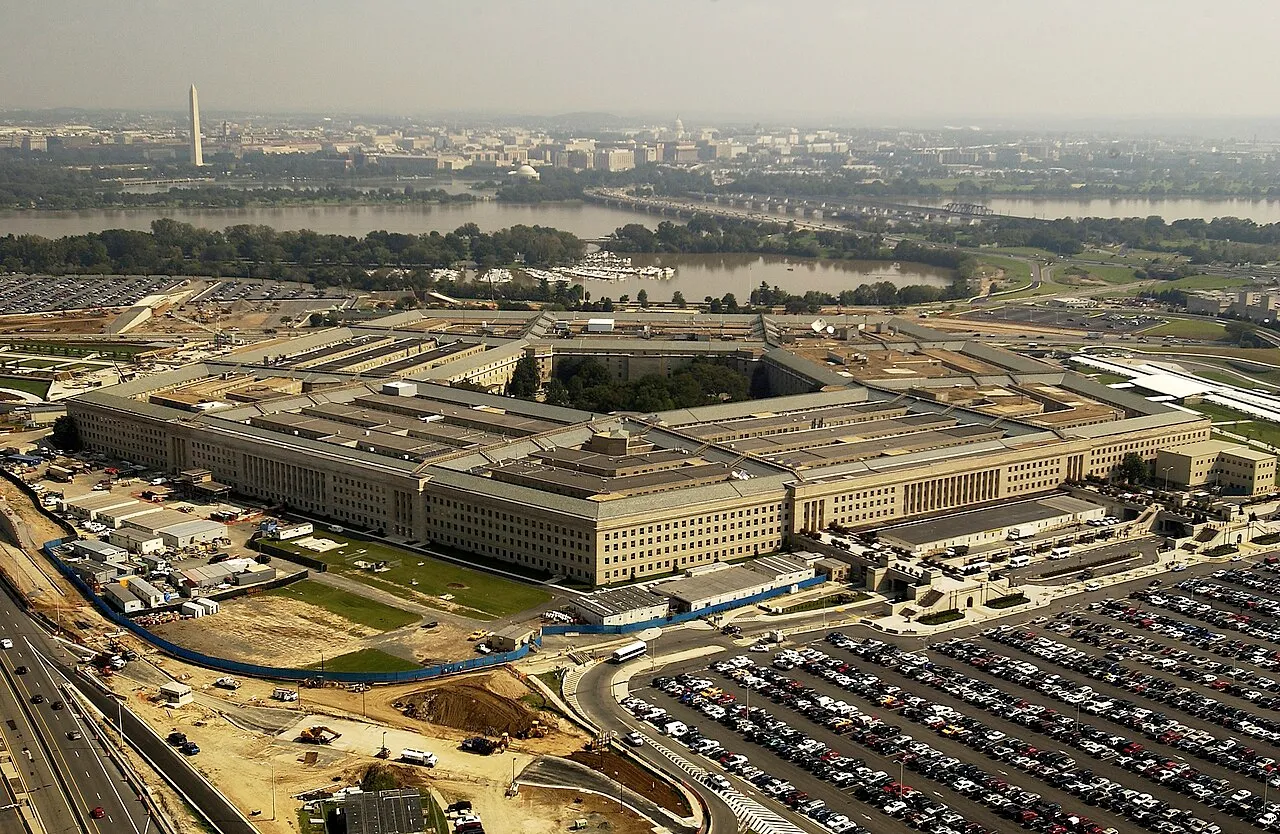
The names sit at the center of daily life in China and, increasingly, in the United States: the company behind a sprawling online marketplace and cloud business, the country’s dominant search engine, and the carmaker that now outsells every other electric-vehicle brand on Earth. On Monday the Pentagon placed all three — Alibaba, Baidu and BYD — on its official list of companies it says support the Chinese military.
The designations came in an updated version of the Defense Department’s Section 1260H list, the federal government’s running roster of “Chinese military companies operating in the United States.” The expanded list now names 188 companies and reaches far beyond shipbuilders and aerospace contractors into the internet, artificial-intelligence, electric-vehicle, robotics and advanced-manufacturing firms that define China’s modern economy. Alongside the three best-known additions, the Pentagon added EV maker Nio, robotics company Unitree and memory-chip maker CXMT, among others.
The timing is what makes the move land hardest. It arrives only weeks after the Beijing summit between President Trump and Xi Jinping, where the two governments announced a trade truce and a new joint investment and trade board — a thaw that the new blacklist now sits awkwardly against. The Pentagon’s action does not impose sanctions, and it does not bar Americans from buying a BYD car or shopping on Alibaba. But it carries a hard deadline: starting June 30, the Defense Department will be barred from signing or renewing contracts with the listed firms, with a broader ban on indirect purchases to follow in 2027.
What the 1260H List Actually Does
Section 1260H takes its name from a provision of the William M. (Mac) Thornberry National Defense Authorization Act for fiscal 2021, which directs the Pentagon to identify Chinese military companies operating in the United States and publish the list. Congress made the exercise a recurring obligation, so the roster is updated and re-issued rather than assembled once. The June update was released Monday and formalized in a Federal Register notice, docket DOD-2026-OS-1288, with the determination made at the level of the deputy secretary of defense.
The label is narrower than a sanction. Being named to the 1260H list does not freeze a company’s assets, block its access to American consumers, or automatically cut it off from the U.S. financial system the way a Treasury designation can. What it does is sever the company from federal defense dollars. Effective June 30, the Defense Department may not enter into, renew or extend contracts to buy goods, services or technology from a listed firm or its affiliates. A second, wider restriction — covering the Pentagon’s indirect procurement, where a listed company’s products reach the government through a contractor or reseller — is scheduled to take effect in June 2027, giving the supply chain a year to adjust.
The list also functions as a signal that ripples well past the Pentagon’s own purchasing. Banks, index providers, insurers and corporate compliance departments treat a 1260H designation as a flashing yellow light, and past additions have prompted investors to trim exposure and partners to reassess relationships. That reputational weight is part of why companies fight so hard to get off the list — and the law gives them a path to try. Entities named in the notice may request reconsideration, and several firms added in prior years have sued in federal court, with mixed results that have sometimes forced the Pentagon to revisit a designation.
The Companies Push Back
The three marquee additions rejected the label within hours and signaled they would contest it.
Alibaba was the most pointed. “There’s no basis to conclude that Alibaba should be placed on the Section 1260H List,” the company said, adding that it “is not a Chinese military company nor part of any military-civil fusion strategy.” The firm said it would “take all available legal action against attempts to misrepresent our company.”
Baidu, which has staked its future on artificial intelligence and autonomous driving, was equally blunt. “The suggestion that Baidu is a military company is entirely baseless,” the company said, vowing that it would “not hesitate to use all options available to us to have the company removed from the list.”
BYD, the world’s largest seller of electric vehicles, said it firmly opposed being labeled a military company and would use all “feasible administrative and legal means” to protect its interests.
Markets reacted, though not dramatically. In U.S. trading after the announcement, Alibaba’s American depositary receipts slipped about 1 percent, Baidu’s fell roughly 2 percent, and BYD’s traded modestly lower. The muted response reflects the gap between a designation and a true sanction: investors have learned that a 1260H listing constrains a company’s dealings with the U.S. government and raises its compliance costs without, on its own, locking it out of global markets.
A Separate Track From the Trade Truce
The awkwardness of the moment is real, but the 1260H process is not the same machinery that produced the Beijing deal. Trade policy runs through the White House, the U.S. Trade Representative and the Treasury; the military-companies list is a statutory Defense Department exercise that Congress requires regardless of where trade talks stand. The two tracks can — and on Monday did — point in opposite directions.
That tension was visible only weeks ago, when the trade truce the two governments announced on the summit’s first day was paired with warm optics, including the delegation of American chief executives — among them Tesla’s Elon Musk and Nvidia’s Jensen Huang — that accompanied Trump to Beijing. The new blacklist complicates that narrative, putting a national-security stamp on some of the same Chinese champions that American firms have been courting.
Beijing treated the move as part of a pattern. A spokesperson for China’s foreign ministry said the country would “take necessary measures to protect Chinese companies’ legitimate rights and benefits,” and accused Washington of “drawing up various discriminatory lists targeting Chinese firms under the pretext of national security.” The response stopped short of announcing retaliation, leaving open whether the designation will register as a manageable irritant or a genuine strain on a truce that is only weeks old.
For American policymakers, the dual-track approach is partly the point. It lets the administration pursue tariff relief and investment deals on one channel while keeping a defense-procurement firewall on another — a way of doing business with China’s economy without funding what the Pentagon views as its military-industrial base.
What Comes Next
The first concrete consequence arrives June 30, when the direct-contracting prohibition begins. For most of the newly listed consumer brands, the immediate practical effect is limited — the Pentagon was never a major customer of an online retailer or a search engine. The sharper bite is reputational and forward-looking, and it falls hardest on firms with ambitions in robotics, AI, chips and electric vehicles that might otherwise have brushed up against U.S. government supply chains.
The next phase is litigation. Alibaba and Baidu have both said they will pursue removal, and the reconsideration process plus the federal courts are where that fight will play out over the coming months. Prior cases suggest the outcome is not preordained: the Pentagon has prevailed in some challenges and been forced to delist or re-justify in others.
The larger question is whether the designation bleeds into the trade relationship the Beijing summit was meant to stabilize. The truce and the new list now coexist, one signed by negotiators and the other by the Pentagon. Which one defines the next chapter of U.S.-China economic relations will depend less on Monday’s notice than on how Beijing and Washington choose to read it.
Sources 6 cited · 2 primary
- Entities Identified as Chinese Military Companies Operating in the United States in Accordance With Section 1260H
- Notice of Availability of Designation of Chinese Military Companies (Docket DOD-2026-OS-1288)
- Alibaba, Baidu, BYD named on Pentagon's China military list
- Pentagon accuses Alibaba, Baidu and BYD, three of China's biggest companies, of supporting the Chinese military
- US adds Alibaba, BYD and other Chinese tech champions to military company list
- US Department of Defense Issues Updated Section 1260H Chinese Military Companies List
American Courant cites its sources and links to primary documents where they exist. How we report →