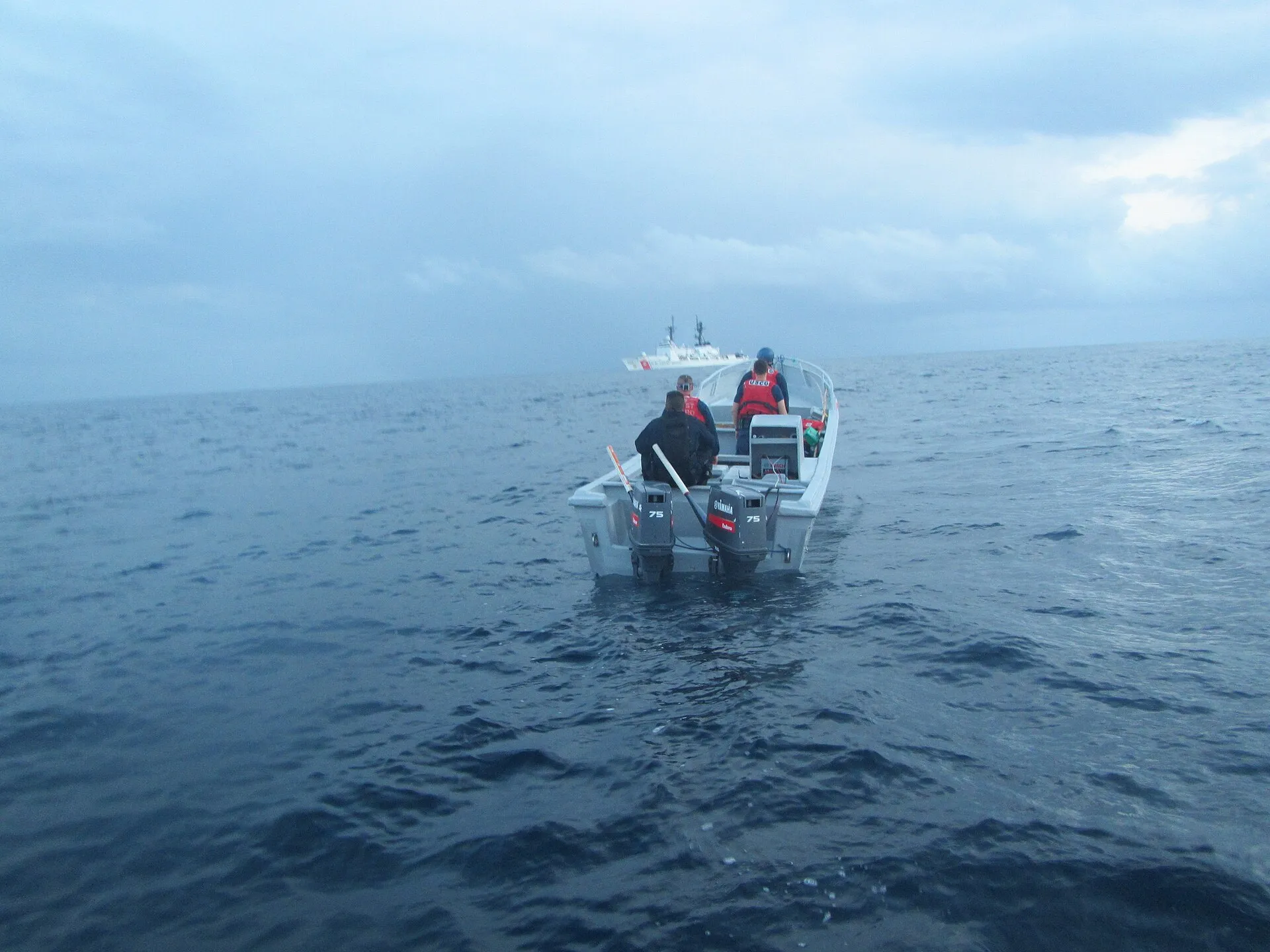
On Monday, a U.S. military strike in the eastern Pacific destroyed a small boat the government described as a drug-smuggling vessel, killing one man and pulling two survivors from the water. U.S. Southern Command said the strike was carried out “at the direction” of Defense Secretary Pete Hegseth. It was an unremarkable day in a campaign that has stopped feeling remarkable, and that is the problem.
By the Pentagon’s own running count, the strikes the administration began in early September have now killed at least 208 people across the Caribbean and the eastern Pacific. No court has reviewed a single target. No jury has weighed a single case. In most instances the government has not publicly released the evidence that the boats it blew apart were carrying drugs at all. The campaign’s climbing death toll has become a line item, updated and forgotten.
Here is the part worth saying plainly: the danger is not really about drugs. It is about a president asserting the authority to kill people the executive branch alone has labeled the enemy, in international waters, with no charges, no evidence shown to anyone, and no vote of Congress, while a political system decides strike after strike to look away. Whatever you think of drug cartels, that is a power that will outlast this administration and this drug war. And it is being claimed against the least sympathetic targets imaginable, which is precisely how dangerous precedents are always set.
What the Government Is Actually Claiming
The administration’s legal theory is that the United States is fighting a “non-international armed conflict” against drug-trafficking organizations it has designated as terrorist groups. Under that framing, the men on these boats are not criminal suspects entitled to interdiction, arrest, and trial. They are enemy combatants who can be killed on sight.
Two problems with that theory compound each other. The first is legal. The administration has never identified a statute in which Congress authorized a sustained shooting war against smugglers, and the “armed conflict” label is a designation the executive applied to itself. The second is evidentiary. For decades, the Coast Guard and Navy interdicted go-fast boats by stopping them, boarding them, seizing the cargo, and arresting the crew, a process that produced evidence anyone could later examine in open court. Lethal strikes produce no such record. When the government incinerates a boat and announces afterward that it held narcotics, there is no longer any way for an outside party to test the claim. The proof, if it existed, is at the bottom of the ocean.
That gap matters because the targeting has not been clean. American Courant’s own review of the campaign found serious, unresolved doubts about who some of the dead actually were, and the Pentagon’s inspector general has opened a review of how targets get selected. “Trust us” is the entire evidentiary standard on offer, and it is being offered by the same officials who decide who lives and who is vaporized.
What began as a handful of strikes in the Caribbean last September has hardened into standing policy. The military has now carried out more than 50 strikes and pushed the campaign west into the eastern Pacific, far from any U.S. shore, with the Defense Department narrating each one in the clipped cadence of a routine press release. The emergency framing that justified the first strikes has quietly become the permanent operating procedure for the next two hundred. Monday’s single death barely registered as news, which is its own kind of warning: a country gets used to almost anything if the announcements arrive often enough.
The Counterargument, Taken Seriously
The case for the strikes deserves a straight answer rather than a caricature. Fentanyl and cocaine flowing into the United States kill tens of thousands of Americans every year, and the old interdiction model plainly failed to choke off the supply. Administration officials argue that the smuggling networks are sophisticated, heavily armed, and effectively at war with the states they move through, and that treating their operatives as criminal defendants, with lawyers and discovery and years of appeals, is a luxury the crisis cannot afford. From that vantage, a faster and harder response is not lawlessness. It is overdue.
There is also a constitutional wrinkle the critics tend to skip past: Congress has not actually been silent. The Senate voted on War Powers resolutions to halt the strikes in 2025 and again in 2026, and both times a majority declined to stop them. One bipartisan measure, pushed by Senators Tim Kaine, Rand Paul, Adam Schiff, and Chuck Schumer, fell just two votes short. You can call that failure cowardice. You cannot quite call it the absence of consent. The elected branch looked directly at this campaign and chose, narrowly, not to end it.
Both points are serious. Neither survives contact with the precedent problem.
Why the Precedent Is the Real Stake
Take the strongest version of the government’s case and grant all of it. Assume every boat truly was carrying drugs, every man truly was a smuggler, and the cartels truly are as dangerous as advertised. The constitutional objection does not go away, because the Constitution does not let the executive serve as the judge of its own evidence.
The power being asserted is not “we can kill drug smugglers.” It is “we can define a category of people as combatants, decide on our own that an armed conflict exists, and kill members of that category without showing the proof to anyone.” That power does not stay pointed at go-fast boats. Once the country accepts that a president can manufacture a war by labeling it one, and that the Senate’s failure to muster a majority counts as authorization, the same logic is available for the next category, the next president, and the next declared enemy. Precedents do not come with expiration dates.
This is exactly why the unsympathetic targets are not a reason to relax. They are the reason to pay attention. Nobody builds a machine like this around defendants the public is inclined to defend. It gets built around accused smugglers, and then it sits there, fully assembled, waiting for whatever comes next.
Why It Matters Now
Two votes. That is how close the Senate came, on its better attempt, to reasserting the basic idea that killing people in America’s name requires America’s elected representatives to say yes. It did not get there, so the strikes continue on a timetable set entirely inside the executive branch, the toll climbing past 200, the eastern Pacific now a routine killing ground.
The honest position is not that every target was innocent. We do not know, and that uncertainty is itself the indictment. The honest position is that a self-declared war with no charges, no trial, no public evidence, and no real congressional authorization is the precise kind of unchecked power the framers spent a long summer in Philadelphia trying to deny any single person. The boats are small. The thing being normalized is not.
Sources 6 cited · 2 primary
- US strike on an alleged drug boat kills 1, leaves 2 survivors in the eastern Pacific Ocean
- Latest U.S. strike on alleged drug boat in eastern Pacific kills 1, leaves 2 survivors, Pentagon says
- What to know about U.S. military strikes on alleged drug boats
- The boat strikes are still happening. Five things you need to know.
- Senate Republicans Block Sens. Schiff, Kaine's War Powers Resolution Aimed at Ending Unauthorized Boat Strikes in Caribbean
- Senate votes down war powers resolution aimed at blocking Trump's strikes on alleged drug boats
American Courant cites its sources and links to primary documents where they exist. How we report →