Dr. Peter Stafford had been performing surgery at Nyankunde Hospital in Bunia, in the eastern Democratic Republic of Congo, when he was exposed to the Bundibugyo ebolavirus. By Sunday morning he had developed symptoms consistent with the disease. By Sunday night he had tested positive. By Tuesday, he was aboard a medical evacuation flight to Germany, where he is being treated in a high-isolation unit.
Stafford, a board-certified general surgeon who has worked at Nyankunde — a mission hospital in Bunia, the administrative capital of Ituri Province — since 2023 for the Christian missionary organization Serge International, is the first American known to have contracted the Bundibugyo strain during the current outbreak. His wife, Dr. Rebekah Stafford, and at least five other American medical workers connected to the same hospital are being monitored in Germany for potential exposure. Two of those individuals had shown no symptoms as of Monday; all are under full observation.
On Tuesday, WHO Director-General Dr. Tedros Adhanom Ghebreyesus said he was “deeply concerned about the scale and speed” of the outbreak. The officially confirmed count — 30 laboratory-confirmed cases, more than 500 suspected, and 131 deaths — almost certainly understates the true scope, he said, pointing to the high positivity rate on tested samples and the outbreak’s spread to nine health zones across Ituri Province. “The increasing trends in syndromic reporting of suspected cases and clusters of deaths across Ituri all point toward a potentially much larger outbreak than what is currently being detected,” the WHO said in its emergency declaration.
This outbreak, which the WHO declared a public health emergency of international concern on Sunday after the virus had been circulating undetected for nearly three weeks, has now produced the first evacuation of a sick American for Ebola treatment since the West Africa crisis of 2014–2016.
A Surgeon Who Didn’t Know the Zone Was Active
Stafford’s exposure illustrates a central problem of the current response: the outbreak in Ituri Province spread for weeks before anyone knew what was causing the deaths. The field diagnostic machines in Bunia were calibrated to detect the Zaire species of ebolavirus — the strain behind the 2014 West Africa epidemic and the 2018–2020 DRC epidemic. The Bundibugyo strain, a genetically distinct species, returned negative results on those machines.
By the time a laboratory in Kinshasa confirmed the Bundibugyo strain on May 15, roughly 80 people had already died. Every test during that silent period — perhaps 13 or more samples, based on WHO figures — was taken with equipment that could not see what it was looking for.
Stafford performed surgery on a patient at Nyankunde without knowing that Ebola was present in the hospital’s patient population. The hospital serves patients from across the Ituri region and is one of the few facilities in eastern Congo with dedicated surgical capacity. Serge International operates the hospital as part of a broader medical mission in the DRC; the organization has no specific Ebola response protocol, because Nyankunde had not been listed as an active Ebola contact point before the May 15 confirmation.
The evacuation was organized by the CDC and the U.S. Embassy in Kinshasa. According to a CDC statement, the six Americans now in Germany include at least two physicians and one or more other healthcare workers. Germany has handled multiple Ebola evacuations before — including cases during the 2014–2016 West Africa epidemic — and its federal hospitals have purpose-built high-containment treatment units.
A Death Toll That May Be Far Higher
The 131 deaths and 500-plus suspected cases in the official count describe a floor, not a ceiling. The WHO has been explicit about this. When the Bundibugyo strain remained undetected for three weeks before May 15, all of the disease activity during that window was recorded only as “suspected” hemorrhagic fever deaths in the syndromic surveillance system — not as laboratory-confirmed Ebola.
The outbreak now spans at least nine health zones in Ituri Province. Cases have appeared in Bunia and its surrounding districts, in Rwampara, in Mongbwalu, and in communities along the major road corridors connecting Bunia to Uganda and the DRC’s interior. Two confirmed cases have been reported in Kampala, Uganda’s capital. The first — a 59-year-old Congolese man who had traveled from Ituri — died at Kibuli Muslim Hospital in Kampala on May 15. A second confirmed Ugandan case followed the next day. A third case appeared in Kinshasa, more than 1,500 miles from Bunia, also linked to Ituri travel.
Conflict makes the true count harder to establish. Ituri Province is one of the most volatile areas in eastern Congo, with multiple armed groups operating in the hinterland between health zones. Humanitarian agencies have reported that more than 100,000 people have been newly displaced in Ituri in the past two months alone. Response teams traveling to affected communities outside Bunia require armored escorts; several planned site visits have been delayed due to active security incidents. In areas where teams cannot operate, traditional community burial practices continue — practices that have historically driven secondary Ebola transmission because they involve direct contact with the bodies of the deceased.
The Africa Centers for Disease Control and Prevention, in its own parallel emergency declaration, described the outbreak as a Public Health Emergency of Continental Security — a higher designation than a standard PHEIC — citing the confirmed spread to Uganda’s capital and the volume of cross-border movement in the Great Lakes region.
The United States Responds
Monday’s federal response went beyond what the U.S. government did during early stages of prior Ebola outbreaks. The Department of Homeland Security and the CDC announced entry restrictions that officials described as the first Ebola-specific travel ban in American history.
Under the measure — issued under Title 42 authority — foreign nationals who have been in the Democratic Republic of the Congo, Uganda, or South Sudan within the past 21 days are barred from entering the United States. The 21-day window corresponds to Bundibugyo’s maximum known incubation period. U.S. citizens and permanent residents returning from those countries must complete a health screening at designated ports of entry and submit to a 21-day self-monitoring protocol; anyone developing symptoms faces immediate public health isolation.
Enhanced airport health screening is now in place at ports of entry that receive flights routed through Nairobi, Addis Ababa, Dubai, Amsterdam, and other hubs that handle traffic from the affected region.
President Trump, asked about the outbreak during a White House event Monday afternoon, said: “I’m concerned about everything, but certainly am” about Ebola. He described the virus as “confined right now to Africa.” Dr. Heidi Overton, a physician serving on the White House Domestic Policy Council, said at the same event that “we have stood up a full interagency response” to the outbreak.
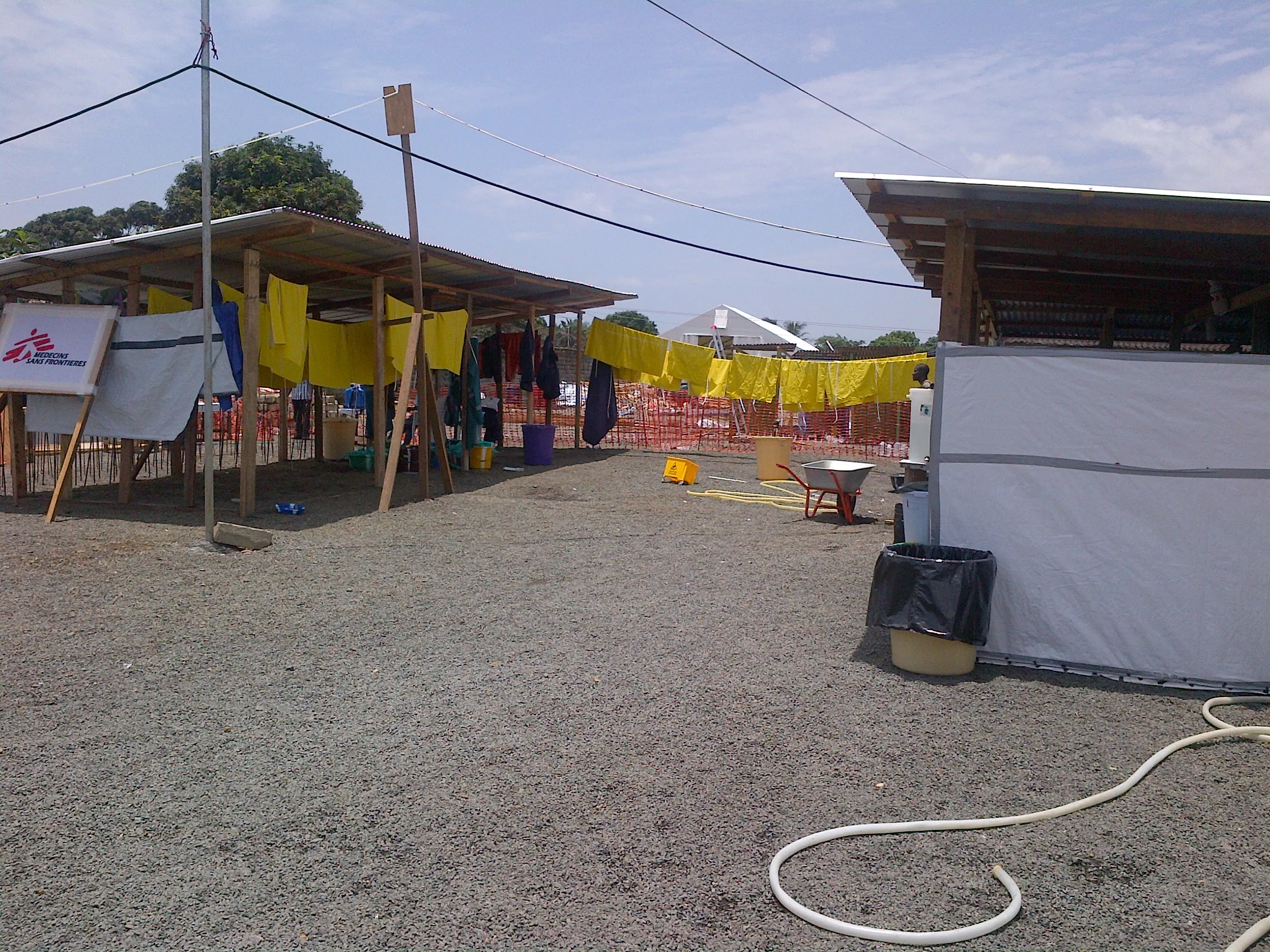
The State Department issued Level 3 (“Reconsider Travel”) advisories for the DRC and Uganda as a whole, and advised Americans against all travel to Ituri Province specifically. CDC personnel are now deployed in both countries, working alongside WHO rapid response teams and Médecins Sans Frontières, which has established an initial treatment unit in Bunia. The agency has been conducting concurrent domestic outbreak responses in 2026, including an ongoing measles outbreak that has put the country’s 25-year disease elimination status under review.
Why Bundibugyo Is Different
Of the six known Ebolavirus species, only the Zaire strain has an approved vaccine. Merck’s ERVEBO, which was highly effective during the 2018–2020 DRC epidemic, works only against Zaire ebolavirus. It offers no protection against Bundibugyo.
There is currently no licensed vaccine and no approved antiviral therapeutic for any Bundibugyo infection. Researchers at the National Institutes of Health and the U.S. Army Medical Research Institute of Infectious Diseases have experimental Bundibugyo vaccine candidates in early-stage development, but none is available at clinical scale. The WHO said Tuesday it is coordinating with pharmaceutical partners about potential compassionate-use deployment of experimental antivirals, but no emergency authorization is in effect.
This is only the third recorded Bundibugyo outbreak in history. The first occurred in 2007 in Uganda’s Bundibugyo District, for which the strain is named, killing approximately 37 people. The second was in 2012 in Isiro, in the northeastern DRC — geographically close to the current outbreak — killing at least 31. Both were contained relatively quickly and were too small to support the clinical trial infrastructure needed for regulatory approval of targeted treatments. The result is that decades after Bundibugyo was first identified, every clinician treating a patient with this strain is working without approved antiviral tools.
Supportive care — intravenous fluids, electrolyte management, oxygen — remains the standard of care, just as it does for Zaire. The mortality rate for Bundibugyo in prior outbreaks ran between 25 and 35 percent with supportive care, lower than the 60 to 90 percent seen in untreated Zaire outbreaks but still severe.
What Comes Next
The WHO emergency committee that convened before Sunday’s PHEIC declaration is expected to meet again this week to assess whether to issue specific travel recommendations. The WHO faced criticism after the 2014 West Africa epidemic for waiting too long to declare a PHEIC; the early declaration here — before the international spread became a major chain — was an explicit response to that history.
Outbreak response in Ituri depends on four things running simultaneously: contact tracing to find people exposed by the undetected phase, treatment capacity to reduce mortality among confirmed cases, community engagement to change burial practices in areas the response has reached, and security to allow teams to operate in the areas it hasn’t. All four are constrained at present.
The 21-day incubation window means the full geographic footprint of the outbreak — including exposure events that happened during the undetected three-week period before May 15 — is not yet visible. Cases seeded during that silent period may still be incubating in communities connected to Ituri by the region’s informal transit networks: buses, motorcycle taxis, and boats on the rivers running between eastern Congo and Uganda, Rwanda, and South Sudan.
Stafford is the second American this year to require federal coordination for a novel pathogen with no approved therapeutic. In March, 18 Americans were placed in federal quarantine in Nebraska after an Andes hantavirus outbreak aboard an Antarctic cruise ship — a case in which three people died before the pathogen was confirmed.
Stafford is expected to receive supportive care and, if available, any experimental antivirals that can be sourced through compassionate-use channels. His prognosis will depend on the timing of his diagnosis relative to symptom onset and the quality of the supportive care available. Bundibugyo survivors in prior outbreaks reported a range of disease severity. Germany’s isolation units have treated Ebola patients before; the care protocols are well established even without a targeted therapeutic.
Sources 6 cited · 4 primary
- Epidemic of Ebola Disease caused by Bundibugyo virus in the Democratic Republic of the Congo and Uganda determined a public health emergency of international concern
- CDC Statement on the Use of Public Health Travel Restrictions to Prevent the Introduction of Ebola Disease into the United States
- United States Responds to Ebola Outbreak in Africa
- Transcript — Update on Ebola Outbreak in the Democratic Republic of the Congo and Uganda, May 18, 2026
- American doctor working in Congo tests positive for Ebola, CDC and aid group say
- WHO chief raises alarm over scale of Ebola outbreak after death toll climbs
American Courant cites its sources and links to primary documents where they exist. How we report →