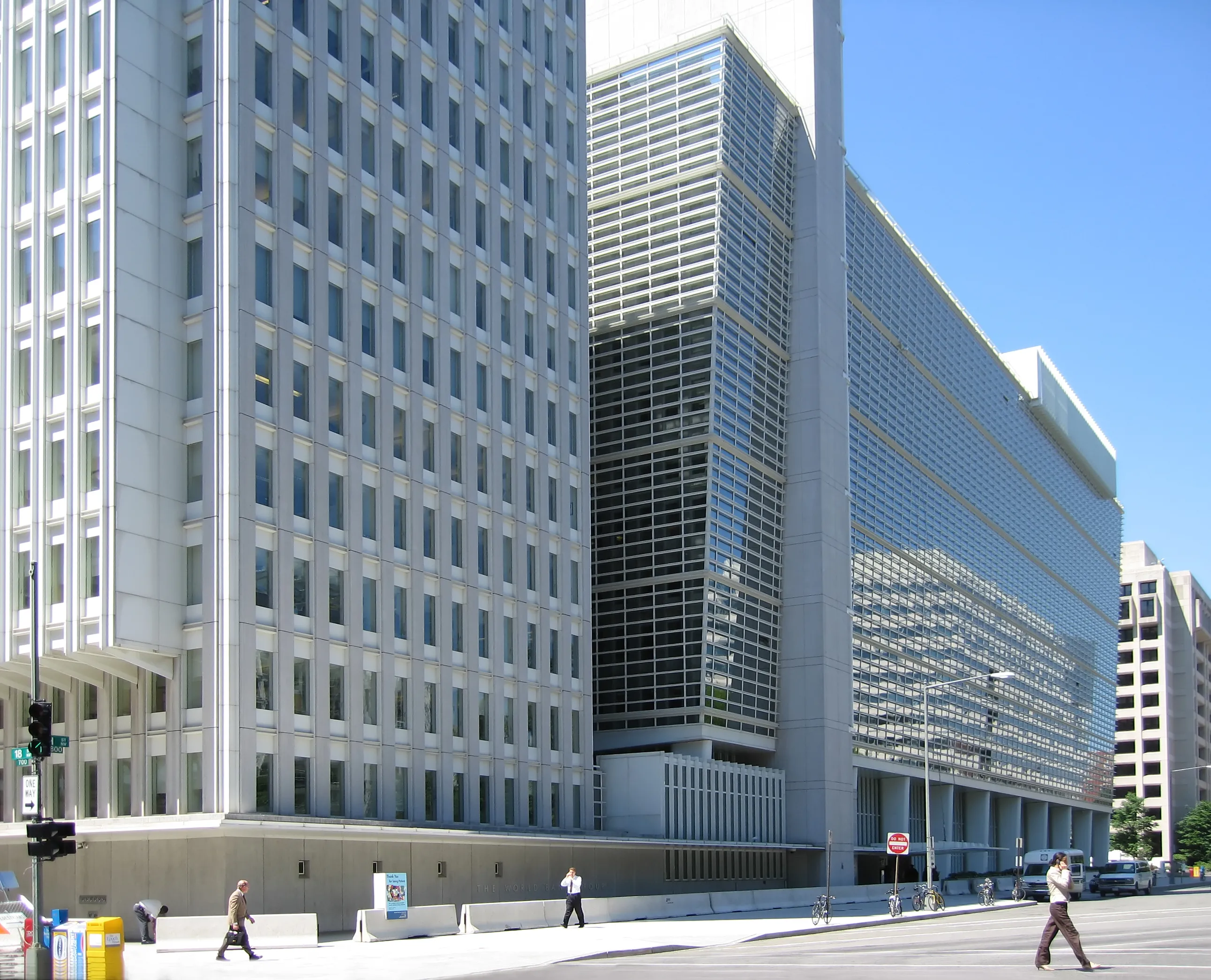
The Middle East war now has a number attached to it, and the World Bank put it in print this week: the weakest year for the global economy since the pandemic.
In its June Global Economic Prospects report, released June 11, the World Bank cut its forecast for global growth in 2026 to 2.5 percent, down from 2.9 percent in 2025 and the slowest pace since the onset of COVID-19 in late 2019. The downgrade was broad — forecasts for roughly two-thirds of the world’s economies were marked lower than they had been just five months earlier — and the bank named a single dominant cause: a conflict that has driven energy prices up, kept inflation sticky, and pushed borrowing costs higher across much of the world.
Why It Matters
A World Bank forecast is not market-moving the way a Federal Reserve decision is. What it offers instead is a measured, comprehensive verdict on where the world economy stands, and the June verdict is grim in a specific way. It tells households and businesses that the squeeze of the past year — pricier fuel, stubborn inflation, interest rates that refuse to fall — is not a passing disruption but the baseline the bank now expects to persist.
The forecast also reframes a war that has dominated headlines as an economic event with a global price tag. American Courant has tracked the conflict through Trump’s claim of an Iran settlement that briefly sank crude prices and the repeated scares over the Strait of Hormuz. The World Bank’s contribution is to translate those swings into output, jobs and prices — to show that a regional war reaches the cost of a tank of gas in Ohio and the rate on a mortgage in Madrid through the same channel: oil.
Indermit Gill, the bank’s chief economist, framed the deeper problem bluntly. “The world economy is a lot less resilient today than it was in 2008 and even as compared with 2018,” Gill told reporters, pointing to a future of high policy uncertainty, inflationary pressure and elevated interest rates. That is the worry beneath the single-year number: the global economy is absorbing a shock with thinner reserves than it had the last two times it was tested.
The Oil Shock Driving the Downgrade
The mechanism is straightforward. The bank’s baseline now assumes Brent crude averages about $94 a barrel in 2026 — roughly 36 percent above its 2025 level — as the conflict keeps a risk premium on every barrel and the threat to Gulf shipping lanes lingers. Higher energy costs feed directly into inflation, which the bank expects to hold near 4 percent globally rather than easing back toward the targets central banks prefer. Persistent inflation, in turn, keeps interest rates higher for longer, which raises the cost of everything bought on credit, from cars to corporate expansion.
Each link in that chain drags on growth, and the drag is not evenly shared. Energy-importing economies — most of the developing world, plus much of Europe and Asia — bear the brunt, paying more for fuel they cannot produce at home. The result is the two-thirds downgrade: a synchronized markdown rather than a localized one.
The pain is sharpest for poorer countries that import their fuel and carry heavy debt. For them, a higher oil bill and higher global interest rates arrive together, and the second amplifies the first: governments that borrowed heavily through the pandemic and its aftermath must now refinance that debt at elevated rates, leaving less room to cushion their own citizens from costlier energy and food. That squeeze on fiscal space is part of what Gill meant about a less resilient world. In 2008 and again in 2018, many governments had the borrowing capacity to spend their way through a shock. A decade of accumulated debt has narrowed that option.
Not every figure was bleak. India remained the fastest-growing major economy, with output projected to expand 6.6 percent in 2026 after 7 percent the year before, and South Asia stayed the strongest-performing region even as its growth slowed. But the regional bright spots sit inside a darker whole. The bank expects global growth to recover only modestly, to about 2.8 percent in 2027 and 2028 — and even that rebound would land roughly 0.4 percentage point below the average pace of the 2010s, held back by slower population growth, weaker private investment, shrinking public investment, rising government debt and softer trade. The bank’s economists have taken to calling this the world’s lost dynamism: not a crash, but a persistent, grinding slowdown that compounds quietly year over year.
How Much Worse It Could Get
The 2.5 percent figure is the bank’s central case, not its worst one. The report sketches a downside scenario in which global growth falls all the way to 1.3 percent — a level associated with stalled economies and rising unemployment — if energy supply disruptions prove more severe and arrive alongside serious stress in financial markets.
That is the combination economists fear most: a real-economy shock and a financial shock reinforcing each other. A deeper oil disruption would push inflation higher and growth lower at the same time; if it also rattled markets — through a credit crunch, a wave of corporate defaults, or a sharp repricing of risk — the two forces could compound into something far worse than a soft year.
“These risk scenarios show how quickly the outlook could weaken if energy and financial pressure reinforce each other,” said Ayhan Kose, the bank’s deputy chief economist. The point of publishing the 1.3 percent figure is not to predict it but to mark the distance between the base case and the cliff — a distance that has narrowed as the conflict has dragged on.
What It Means for Households, and What Comes Next
For American readers, the forecast lands close to home even though the war does not. The same forces the World Bank describes — costlier energy, inflation that will not quite break, rates that stay elevated — are the ones already visible in the U.S. data, including May’s inflation reading that hit a three-year high and complicated the Federal Reserve’s path. A weaker global economy also means softer demand for American exports and more cautious corporate hiring and investment, the kind of slow drag that shows up in job openings before it shows up in the headlines.
The energy channel is the most direct. Brent crude near $94 a barrel translates into higher prices at the pump and higher input costs for everything that has to be shipped, heated or manufactured — a tax on consumers and producers alike that the United States feels even as a major oil producer of its own, because crude is priced globally. The interest-rate channel is slower but stickier. If global inflation holds near 4 percent, the case for the rate cuts markets have been pricing in weakens, and the cost of mortgages, car loans and business credit stays higher than households had hoped. The combination is what economists mean when they describe a stagflationary tilt: growth that is too slow and prices that are too high at the same time, the hardest mix for any central bank to manage.
The near-term signposts are concrete. Watch the price of Brent crude against the bank’s $94 assumption: a sustained move above it would validate the gloomier path, while a durable de-escalation in the Middle East would pull the baseline back up. Watch whether global inflation eases from the 4 percent the bank now expects, since that is what would finally give central banks room to cut. And watch the credit markets the downside scenario hinges on — the spreads and default rates that would signal whether an energy shock is starting to bleed into finance.
The World Bank’s message, stripped to its core, is that the world is running a more dangerous economy on a thinner cushion than it had in 2008 or 2018. Readers tracking the fallout can follow our business and economy coverage as the oil price, the inflation numbers and the central-bank response decide which of the bank’s two scenarios the next year actually delivers.
Sources 5 cited · 2 primary
- Global Economic Prospects — June 2026 (Press Release): Middle East Conflict Sends Global Growth to Lowest Rate Since COVID-19
- Global Economic Prospects (flagship report)
- World Bank cuts global growth outlook to 2.5%, warns of drop to 1.3% if war fallout spreads to markets
- World Bank lowers 2026 global growth forecast to 2.5%
- World Bank lowers 2026 global growth forecast to 2.5 pct
American Courant cites its sources and links to primary documents where they exist. How we report →