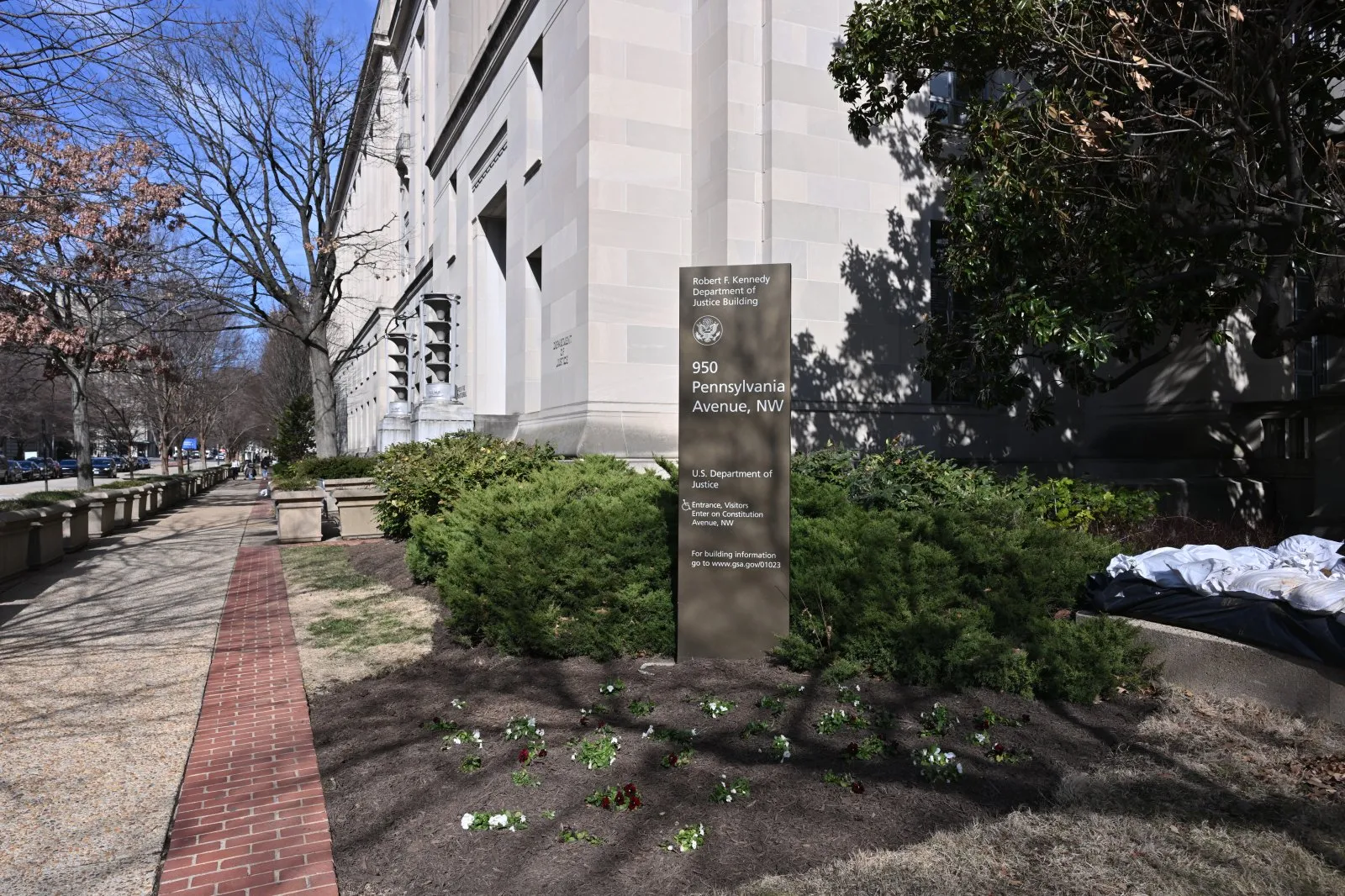
The Justice Department has opened a criminal investigation into E. Jean Carroll, the former magazine advice columnist who won two civil jury verdicts against President Trump, according to separate reporting by CNN, NBC News, CBS News, and Reuters. The probe focuses on whether Carroll committed perjury in a 2022 deposition when she told opposing counsel she had not received outside funding for her lawsuits — a statement her own attorneys corrected on the record roughly six months later.
The investigation also extends to Reid Hoffman, the billionaire LinkedIn co-founder and Democratic donor whose nonprofit, American Future Republic, provided $7 million to the law firm representing Carroll in her cases against Trump. Federal prosecutors are considering possible charges of money laundering, obstruction, and conspiracy relating to the funding arrangement, according to sources with knowledge of the inquiry cited by CNN and CBS News.
The probe is being coordinated out of Chicago, where American Future Republic is headquartered. That attribution, however, runs directly into a public denial: U.S. Attorney Andrew Boutros, the chief federal prosecutor for the Northern District of Illinois, said his office has not opened a criminal investigation into Carroll. Multiple news organizations have confirmed the probe’s existence through independent sourcing, and the discrepancy between the official denial and the reported facts has not been publicly resolved.
Confirmed Facts: The Carroll Cases
Carroll, a former advice columnist for Elle magazine, first publicly accused Trump of sexually assaulting her in a Bergdorf Goodman dressing room in Manhattan in the mid-1990s, in a 2019 essay published in New York Magazine. Trump denied the accusation in terms that Carroll characterized as defamatory, and she sued him for defamation.
After years of procedural litigation — including disputes over whether the lawsuit could advance while Trump held federal office — both cases went to trial in New York federal court.
In May 2023, a Manhattan jury found Trump liable for sexual abuse and defamation and awarded Carroll $5 million in damages. In January 2024, a second jury found Trump liable for defamation in a separate case and awarded Carroll $83.3 million. Trump has appealed both verdicts. The Supreme Court has been asked to consider his appeal of the larger verdict, with the question of whether the federal officer removal statute shields a president from civil litigation still before the justices.
The funding dispute that now sits at the center of a federal criminal probe dates to before either verdict was rendered.
Where the Accounts Diverge
In a 2022 deposition connected to her civil litigation, Carroll stated she had not received outside funding for her lawsuit, according to sources cited by CNN, NBC, and CBS.
Approximately six months after that deposition, Carroll’s attorneys notified the presiding judge and opposing counsel that Carroll “has recollected additional information.” The notice stated that “she now recalls that at some point her counsel secured additional funding from a nonprofit organization to offset certain expenses and legal fees,” according to CBS News reporting on the content of the filing.
The funding had come from American Future Republic. Hoffman’s nonprofit directed $7 million toward the law firm representing Carroll. That involvement was not publicly known until 2023, just before the first trial began — well after Carroll’s deposition and her attorneys’ corrective notice.
Whether the 2022 deposition statement constitutes criminal perjury turns on a narrow legal question: was the statement knowingly and willfully false at the time it was made? Perjury under federal law requires deliberate falsehood, not honest misremembering. The fact that Carroll’s attorneys corrected the record voluntarily — without prompting from opposing counsel or the court — does not automatically shield her from prosecution, but it significantly complicates any argument that she deliberately deceived anyone. Defense attorneys have long argued that voluntary correction undermines the government’s ability to prove intent, the hardest element in a perjury case.
Prosecutors appear to be treating the corrective disclosure as something other than exculpatory. Whether they can establish the requisite intent — that Carroll knew about the funding and deliberately withheld it in a sworn proceeding — is the central legal question any prosecution would have to answer.
What the Investigation Is Actually Targeting
The perjury allegation against Carroll is, by most accounts, the narrower of the two investigative threads. The broader focus, according to sources cited by CNN and CBS, is on Hoffman’s nonprofit and the funding arrangement itself. Prosecutors are examining whether the $7 million directed through American Future Republic to Carroll’s legal team constitutes money laundering, obstruction of justice, or criminal conspiracy.
Those are serious charges that would require demonstrating far more than a technical disclosure failure. Money laundering requires showing that funds were moved to conceal their criminal origin or to disguise the nature, source, or purpose of a transaction. Obstruction of justice requires showing an intent to impede a federal proceeding. Conspiracy requires an agreement between two or more parties to commit a federal crime.
The legal theory linking a litigation funder’s nonprofit disbursement to those charges is not immediately apparent from public reporting. Federal courts have increasingly grappled with third-party litigation funding — arrangements in which outside investors or entities underwrite legal costs in exchange for a share of any recovery — but the practice is not per se illegal. Disclosure requirements vary by court and district. In the federal courts in New York, where Carroll’s cases were litigated, courts have required disclosure in some circumstances but do not impose a blanket pre-suit disclosure obligation on all third-party funding arrangements.
Acting Attorney General Todd Blanche recused himself from the investigation, according to CBS News, though the reason for the recusal was not disclosed publicly.
The Boutros Denial and What It Means
The public statement by U.S. Attorney Boutros has introduced genuine ambiguity into an already politically charged situation. Boutros said his office “has not — and has never opened — a criminal investigation into E. Jean Carroll,” a statement first reported by Global News.
That denial does not necessarily contradict the reported existence of the probe. DOJ investigations touching on high-profile political matters are sometimes managed through Main Justice in Washington rather than through regional U.S. Attorney offices, even when the underlying conduct occurred in a regional jurisdiction. The investigation may be run through DOJ’s Criminal Division, the Public Integrity Section, or another component that operates independently of the NDIL.
None of the news organizations that have confirmed the probe have publicly identified the specific DOJ component running it. The discrepancy may reflect a genuine disagreement about the facts, a miscommunication about which office has investigative jurisdiction, or a deliberate decision to route the case through a channel that does not require Boutros’s involvement.
Hoffman’s Response
Reid Hoffman addressed the probe in a statement reported by CNN on May 29. He called the investigation “an attempt to silence Trump critics” and pledged to fight it. “I’m going to fight this with everything I’ve got,” he said.
Hoffman, 58, has been one of the most significant Democratic donors of the past decade, backing candidates, legal initiatives, and nonprofits across a range of political and policy fights. American Future Republic, founded in 2019, has funded a number of legal efforts critical of Trump or supportive of plaintiffs in cases against him. Whether the DOJ views the nonprofit’s activities as legally problematic, or whether it is pursuing Hoffman primarily because of his prominence as a Trump opponent, is a question that will be fought out in court if charges materialize.
Carroll has not made public statements about the investigation.
What Comes Next
No charges have been filed as of publication. Criminal investigations frequently proceed for months or years before resulting in charges, or they are quietly closed without any public action. Federal prosecutors open investigations and close them all the time; the probe’s existence alone does not mean Carroll or Hoffman will be indicted.
If charges do come, the most powerful legal defense available to both would be vindictive prosecution — the doctrine holding that the government cannot use criminal charges to punish someone for exercising their legal rights or for prevailing in prior legal proceedings. The threshold for proving vindictive prosecution is high, but the Carroll situation — a Trump accuser, indicted while the man she defeated in two civil trials sits in the White House — would present a textbook set of facts for making the argument.
A federal judge invoked the vindictive prosecution doctrine earlier this month when dismissing charges against Kilmar Abrego García, ruling that Main Justice had brought the case to punish him for winning at the Supreme Court. That ruling named the department’s retaliation problem directly and gave future defendants a detailed roadmap for the argument.
The Carroll investigation arrives alongside the federal indictment of former FBI Director James Comey on threat charges arising from a beach photo on Instagram — a case that has been widely criticized as prosecutorial overreach. The pattern of DOJ actions targeting people who have opposed or sued Trump is increasingly the subject of formal legal challenge, not just political commentary.
For Carroll, the legal exposure is real even if the perjury theory is weak. Federal investigations cost defendants enormous sums in legal fees, consume years of their lives, and carry reputational consequences regardless of whether charges are ever filed. For Hoffman, the money laundering and conspiracy theories, if pursued aggressively, could result in criminal liability even absent any criminal wrongdoing by Carroll herself.
Thirty-five former federal judges who filed objections earlier this week over the DOJ’s use of a $1.776 billion anti-weaponization fund to permanently shield Trump from IRS prosecution have raised broader concerns about the department’s institutional direction. The Carroll probe will add to that record.
The next scheduled public development in the case is unclear. No grand jury proceedings, court filings, or prosecutorial deadlines have been publicly disclosed.
Sources 6 cited · 3 primary
- Justice Department opens criminal probe involving E. Jean Carroll testimony in Trump sexual abuse lawsuit
- Justice Dept. investigating outside funding E. Jean Carroll received for civil lawsuits against Trump, sources say
- Exclusive: Justice Department launches a criminal investigation into Trump accuser E. Jean Carroll
- Reid Hoffman says E. Jean Carroll probe involving his nonprofit is meant to 'silence' Trump critics
- DOJ Probes Trump Accuser E. Jean Carroll Over Reid Hoffman Payments
- Top Chicago federal prosecutor says his office did not open investigation into E. Jean Carroll
American Courant cites its sources and links to primary documents where they exist. How we report →