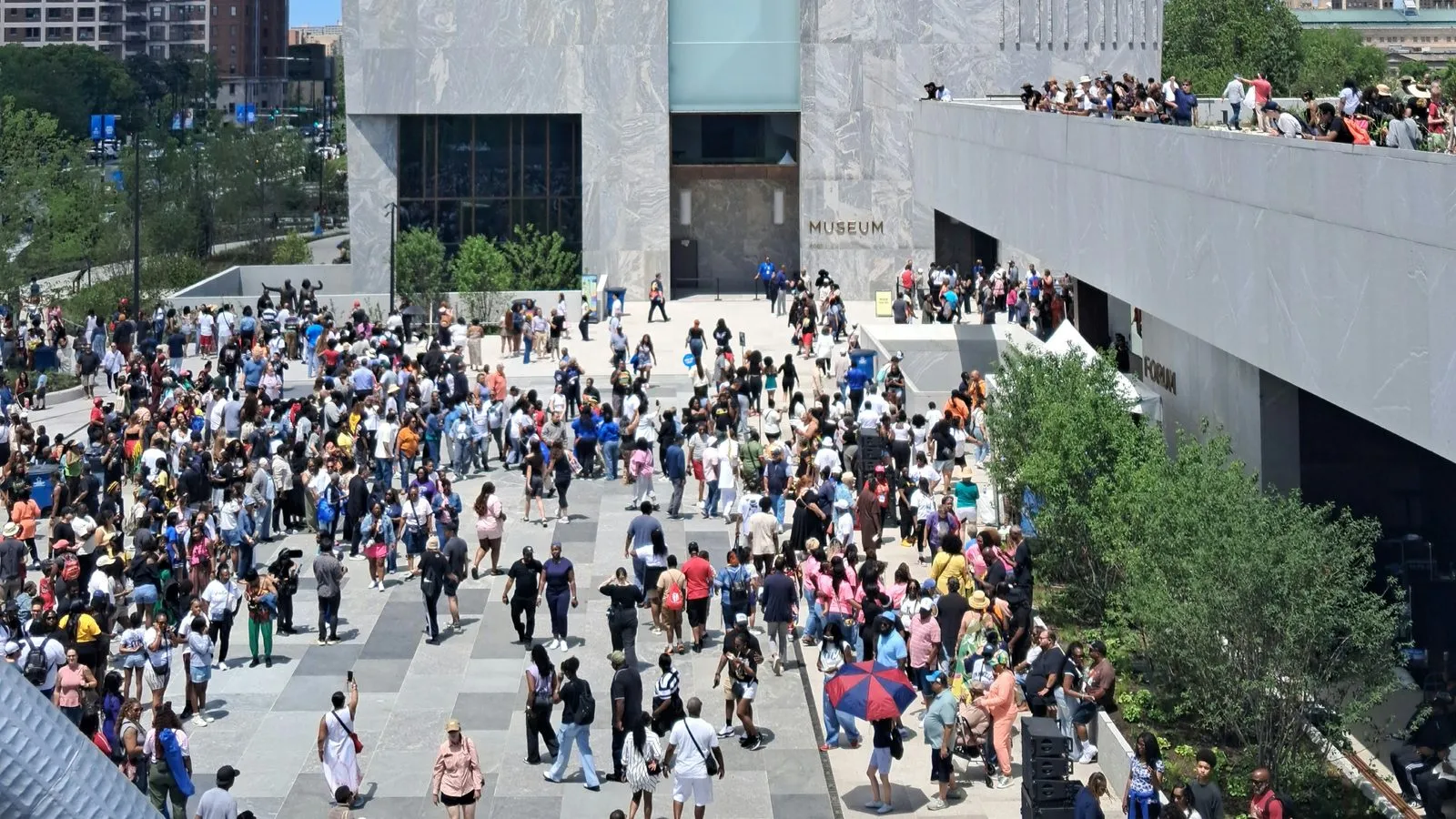
The Barack Obama Presidential Center opened to the public on Juneteenth, June 19, after a dedication ceremony the day before — an $850 million campus on Chicago’s South Side that the former president has called a gift to the community that launched his political career. The celebration also reopened an argument that has trailed the project for nearly a decade: whether building it on public parkland, handed to a private foundation for $10, was a civic investment or a giveaway.
That argument has a charged shorthand among the center’s opponents — “land grab,” and in its most heated form, “stolen land.” Those labels are political characterizations, not legal findings; courts upheld the arrangement at every level, and the City of Chicago retains ownership of the site. But the underlying facts that fuel the criticism are real, documented, and worth laying out plainly, because the loudest claims and the established record do not line up neatly.
A $10 Lease for 19.3 Acres of Public Park
The center occupies 19.3 acres of Jackson Park, the lakefront green space on Chicago’s South Side originally designed by Frederick Law Olmsted and Calvert Vaux and developed for the 1893 World’s Columbian Exposition. Under the agreement the city struck with the Obama Foundation, the foundation received a 99-year use, construction, and maintenance agreement for the land — for a one-time payment of $10.
The key detail that gets lost in the “stolen” framing is ownership. The city did not sell the parkland. Chicago retains title to the site; upon completion, the City of Chicago owns the center itself, with the foundation operating it under the long-term agreement. The $850 million price tag, financed privately, covers a campus that includes a 225-foot museum tower clad in figured gray granite, designed by the New York firm Tod Williams Billie Tsien Architects with Chicago’s Interactive Design Architects. By any measure it is a major public-facing institution. The dispute is not over whether it is impressive. It is over whether public park land should have been used to build it.
The Land Fight in Court
That question went to court, repeatedly, and the Obama side won every time. In May 2018, the preservationist group Protect Our Parks sued to stop the project, arguing that handing a slice of a historic public park to a private entity violated the public trust doctrine — the principle that certain public lands are held in trust for the people and cannot simply be transferred to private control. The group leaned heavily on Jackson Park’s Olmsted-designed heritage and its 1893 lineage.
The courts were not persuaded. U.S. District Judge John Robert Blakey allowed the suit to proceed in February 2019 but, on June 11, 2019, granted summary judgment in favor of the city, dismissing the core challenge. The case wound through appeals, and in August 2021 the U.S. Supreme Court declined to issue an injunction that would have halted construction. Later lawsuits seeking to block or reroute the project were also turned aside, with a judge tossing part of the most recent challenge. The legal verdict, in other words, is settled: the arrangement was found lawful.
The city and the foundation have defended the project as a generational investment in a part of Chicago long starved of one — a museum, library, and programming hub meant to draw visitors and dollars to the South Side. Supporters note that the land remains publicly owned and that the center is a public amenity, not a private office park.
Where ‘Stolen Land’ Comes From
So why does the “stolen” language persist? It comes from the project’s critics, and it runs in two directions.
The first is the public-parkland argument that Protect Our Parks pressed in court: that a unique public resource was effectively privatized, whatever the technical ownership structure, and that a $10 lease for prime lakefront parkland amounts to a giveaway. Courthouse News, covering the appeal, described it bluntly as the “Obama library land grab suit.” That critique lost in court but never disappeared.
The second is a more pointed political jab that resurfaced around the opening. Illinois Republican Party chair Bob Grogan argued that the land “was stolen from the citizens of Illinois, not from the Native Americans,” contending that the parcel — built up over generations through landfill and public works after the Great Chicago Fire — belongs to Chicago taxpayers. His framing was itself a response to a feature of the new center: according to reporting by Fox News and others, the campus includes a permanent display, “Acknowledging Indigenous Peoples’ Land and Territory,” near the museum tower. Critics seized on what they called the irony of an institution acknowledging Indigenous land while standing on parkland its opponents say was taken from the public.
None of that is a finding that anything was literally stolen. It is rhetoric — sharp, politically motivated, and aimed at a Democratic former president by Republican officials and preservation activists. It deserves to be reported as what it is: an argument, attributed to the people making it, not a fact.
What’s Actually True
Strip away the slogans and the verifiable record is straightforward. The Obama Presidential Center sits on 19.3 acres of a historic public park. The city granted the private Obama Foundation a 99-year use agreement for that land for $10, while keeping ownership. Preservationists sued on public-trust grounds and lost at the trial court, the appeals court, and the Supreme Court’s injunction stage. The center cost about $850 million in private money and opened on June 19, 2026.
What remains genuinely debatable is not the legality but the policy: whether leasing a piece of a beloved public park to a private foundation for a nominal sum was the right call, and whether the South Side benefits enough to justify it. Reasonable people land on both sides of that, and the lawsuits were the venue where it was fought. To call the result “stolen land” is to lose that distinction — between a deal critics consider a bad bargain and a deal that was actually unlawful. The courts found it was the former, not the latter, if it was a bad bargain at all.
What Comes Next
With the doors now open, the fight shifts from the courtroom to the verdict of the public the center is meant to serve. The Obama Foundation is betting the campus will draw hundreds of thousands of visitors a year and anchor new economic activity on the South Side, the outcome supporters always promised. Skeptics will watch for the downsides community groups raised throughout the litigation, including concerns about rising costs and displacement in the surrounding Woodlawn and South Shore neighborhoods.
The land question, settled in law, is unlikely to settle in politics. Presidential centers have increasingly become flashpoints over public money and public space, and the Obama Center — the most expensive and most contested of them — will remain a reference point in that debate, the kind of fight American Courant follows across its politics coverage and national news. The slogans will keep circulating. The record underneath them is the part worth getting right.
Sources 6 cited · 1 primary
- Obama Presidential Center (project page)
- Judge tosses part of latest lawsuit challenging construction of Obama Presidential Center in Jackson Park
- Seventh Circuit Hears Arguments in Obama Library Land Grab Suit
- Chicago park activists put fate of Barack Obama Presidential Center in jeopardy
- Obama Center embeds 'Indigenous' land message on controversial site
- Highlights from the Obama Presidential Center opening ceremony in Chicago
American Courant cites its sources and links to primary documents where they exist. How we report →