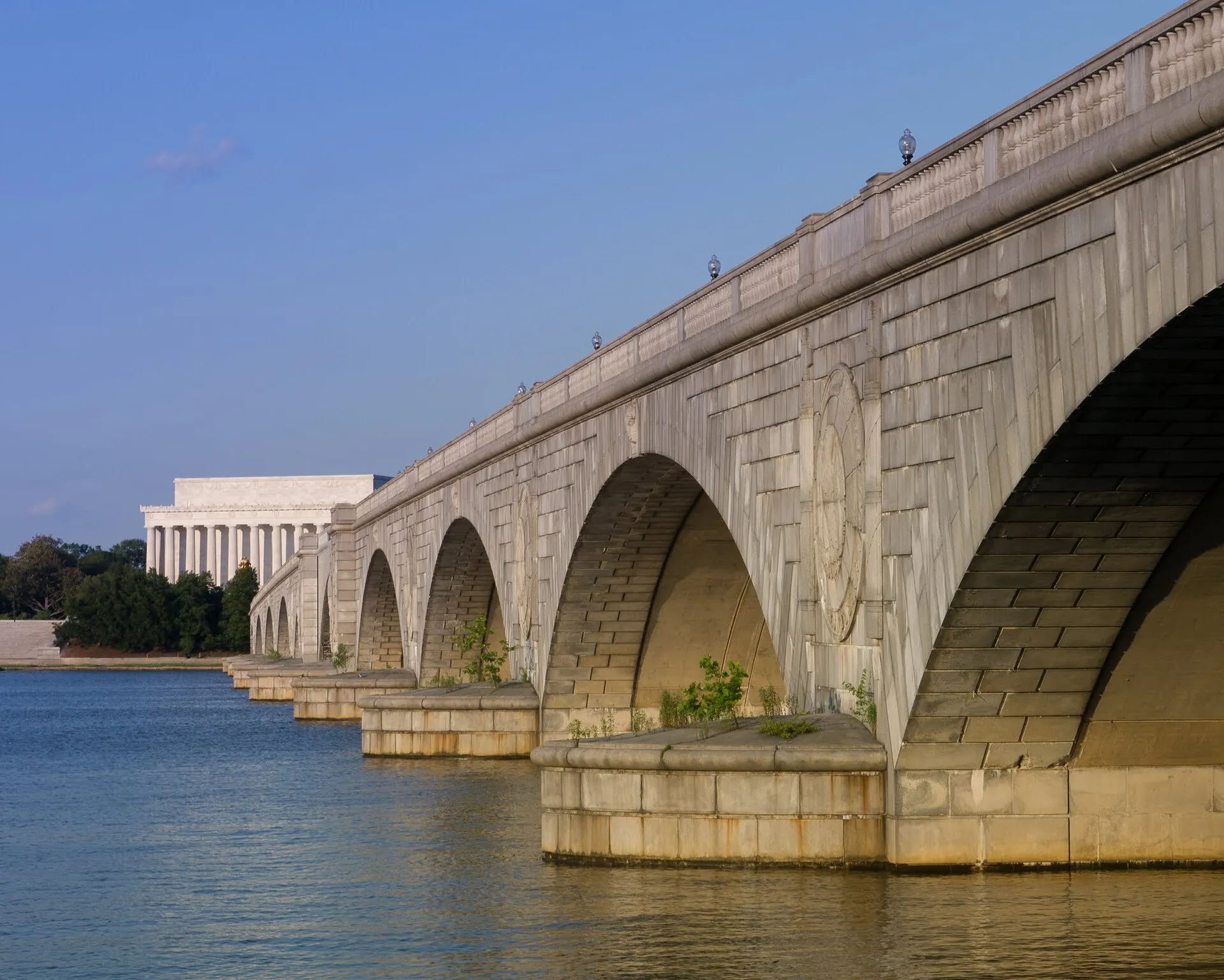
The plan is for a 250-foot gilded arch on Memorial Circle, the roundabout where Arlington Memorial Bridge meets the Virginia shore, a short walk from the entrance to Arlington National Cemetery. It would stand taller than the Arc de Triomphe in Paris and more than twice the height of the Lincoln Memorial across the river. The design crowns the structure with a winged figure holding a torch, sets a gilded eagle on either side, and carries gold inscriptions reading “One Nation Under God” and “Liberty and Justice for All.” The Interior Department says the arch will “celebrate the triumphs of the American people, inspire patriotism and love of country, and beautify our nation’s capital.”
Argue about the gilding if you want. The more important fact is procedural, and it has nothing to do with taste. A monument of this scale, on federal land in Washington, is not supposed to come into existence because a president wants it and the panels he staffs approve the look of it. Under the Commemorative Works Act, new memorials and monuments on federal land in the capital move through a defined process, and major new works are meant to carry the authorization of Congress. President Donald Trump’s arch has cleared the boards the administration effectively controls. It has not cleared the one body the law actually requires. That gap, not the eagles, is the story.
What has actually been approved
It is worth being precise about which approvals exist, because the project’s momentum can be mistaken for legality. The Commission of Fine Arts gave the design final approval on May 21, in a vote critics noted skipped past the commission’s usual multi-stage review. On June 4, the National Capital Planning Commission, a 12-member body chaired by a Trump appointee, voted 9-1 to advance the project. Even that vote came stapled to a list of unresolved problems: pedestrian safety on a busy traffic circle, possible interference with flight paths into Reagan National Airport, obstructed historic sightlines, a conflict with the District’s Height of Buildings Act, and missing detail on lighting, stormwater, and building materials.
Those are design and planning bodies. They judge how a thing looks and how it fits the landscape. They do not, and cannot, stand in for the statutory question of whether the monument is authorized in the first place. The price tag raises the stakes further: the arch is expected to cost at least $100 million, with no finalized public budget. Federal budget documents have already routed millions in taxpayer money toward it, including funds drawn from the National Endowment for the Humanities, an agency whose mission has nothing to do with erecting triumphal arches. When a project this large is being assembled out of approvals from panels the president appoints and line items from agencies repurposed for the task, the absence of a single up-or-down vote by the people’s elected representatives stops looking like an oversight and starts looking like the plan.
The law isn’t a formality
The legal challenge makes the missing step explicit. Three Vietnam veterans, Shaun Byrnes, Jon Gundersen, and Michael Lemmon, joined by the architectural historian Calder Loth, sued on February 19 to stop the project. They are represented by Public Citizen’s litigation group. The plaintiffs’ lead attorney, Nicolas Sansone, has said the case turns on the Commemorative Works Act and Title 40 of the U.S. Code, which require congressional authorization for new memorials and monuments on federal land in Washington. The suit also argues the administration shortcut required historic-preservation and environmental review.
A judge has so far declined to issue a preliminary injunction, and a Justice Department motion to dismiss is pending before U.S. District Judge Tanya Chutkan, with a hearing expected this month. The courts may yet side with the government on the technical reach of these statutes. But notice what is happening in Congress at the same time: House Democrats have introduced a bill aimed at blocking the arch. The existence of legislation to stop it, and earlier efforts to authorize it, is itself a tell. You don’t need a vote to permit something the executive can already do alone. The fight over a bill is a fight over the step the administration is trying to leap.
A triumphal arch at the gate of the dead
Then there is the location, which deserves to be said plainly. A triumphal arch is, by design and by history, a victory monument. Rome built them for returning generals. Paris built one for Napoleon’s armies. They are about conquest and the celebration of power in the present tense.
Arlington is the opposite kind of ground. It is where the country buries the people who paid for its wars, and its meaning is sacrifice, not triumph. Planting a gilded victory arch at the threshold of that cemetery doesn’t extend Arlington’s meaning. It competes with it. The veterans suing the government have framed their objection not as partisanship but as loyalty to the place itself, and that instinct is the honest one. This is the same reflex visible in the proposed $250 bill carrying the president’s face and signature: the urge to convert shared civic space into a personal monument, and to do it fast, before anyone with the standing to object can finish objecting.
The honest counterargument
There is a real case on the other side, and it should get a fair hearing. Washington is a deliberately monumental city. The Mall is a designed landscape, and presidents from Jefferson to Franklin Roosevelt left their mark on it. Grand patriotic architecture is not, in itself, an abuse, and plenty of beloved capital landmarks faced loud opposition when they were proposed. The arch’s design did pass through the official aesthetic review process, and as of today nothing illegal has been built. A supporter can reasonably say this is ambition, not lawlessness.
Take the point seriously, then look at what it leaves out. None of those earlier monuments is the issue. The issue is process: whether an administration can will a 25-story monument onto federal parkland by stacking the review boards and daring Congress to stop it. If the answer is yes, the Commemorative Works Act becomes a suggestion, enforceable only when the sitting president feels like honoring it. That is not a power that stays put. It belongs to whoever wins the next election, too.
Why it matters now
This is not a hypothetical for some future term. The design is approved, the planning commission is advancing it, the lawsuit is live before Judge Chutkan, and reporting indicates construction would demand 20-hour workdays for roughly three years if it proceeds. The decisions are being made this summer.
The arch fits a wider habit this administration has shown of treating legal guardrails as obstacles to route around rather than rules to honor, from the way it moved to hollow out the national intelligence office through an acting director to its handling of the currency rules. The arch is a louder, taller version of the same move.
So the question worth keeping in view isn’t whether a 250-foot arch is handsome or garish. It’s whether the law that says Congress authorizes the nation’s monuments still means anything once a president decides he would rather not ask. If it can be skipped this time, it can be skipped next time, by someone whose triumph you may not want carved in gold beside the war dead.
Sources 6 cited · 1 primary
- 40 U.S. Code § 8903 — Procedures for establishing commemorative works (Commemorative Works Act)
- Veterans and relatives see no place for Trump's arch near Arlington National Cemetery
- Commission of Fine Arts gives Trump's arch final approval, despite public pushback
- U.S. Commission approves modified design for Trump's arch
- House Democrats introducing bill in bid to block Trump arch project
- For a group of Vietnam vets, opposing Trump's arch is about being 'loyal to the country'
American Courant cites its sources and links to primary documents where they exist. How we report →