The most-watched weeknight broadcast in the eleven-year history of The Late Show with Stephen Colbert aired Thursday night, May 21, 2026. It was also the last one. Preliminary Nielsen numbers reported by CNN, Deadline, and The Hollywood Reporter put the finale audience at 6.74 million viewers — a figure that exceeds Colbert’s first night behind the desk on September 8, 2015, when 6.55 million people tuned in to see him replace David Letterman.
The show CBS canceled last summer signed off with more viewers than it had on the night CBS announced it as a franchise relaunch.
Colbert hosted 1,801 episodes between those two broadcasts. The finale roughly doubled the show’s recent season average, which Variety and LateNighter put between 2.4 and 2.7 million viewers per night in the program’s final months. It did not reach the 13.76 million Nielsen reported for Letterman’s own farewell on May 20, 2015, but it was the kind of number broadcast late-night television has not produced in years.
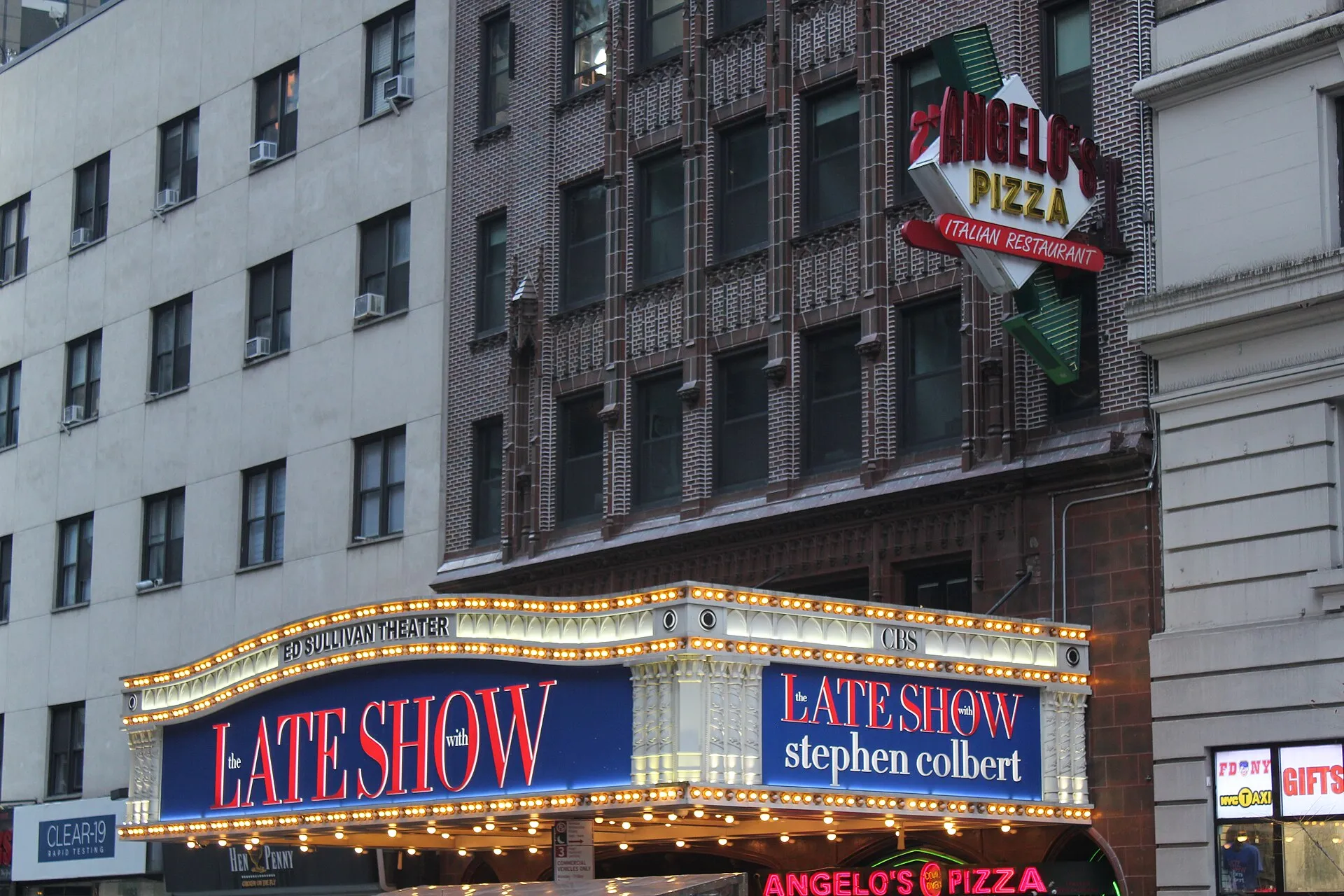
CBS will not replace it with another late-night talk show. On Friday night, May 22, the 11:35 p.m. Eastern slot was filled by Comics Unleashed with Byron Allen, a syndicated stand-up roundtable Allen first launched in 2006 and is now leasing into the slot under a time-buy arrangement. The Late Show franchise, which David Letterman launched at the Ed Sullivan Theater on August 30, 1993, retired at 12:35 a.m. Eastern on Friday morning. Less than 19 hours later, a different company put a different format in the same chair.
How the finale played out
The closing episode leaned hard on the room itself. Colbert had spent the final two weeks bringing back the figures most associated with the building and with his arc onto network television. Letterman appeared on May 14 and joined Colbert on the roof of the Ed Sullivan Theater for a stunt in which stagehands launched the show’s blue guest sofas, Colbert’s desk chair, watermelons, and a CBS-branded sheet cake off the building onto a target painted on the sidewalk. Jon Stewart appeared with Steven Spielberg on Tuesday, May 19, with a performance by Talking Heads frontman David Byrne. Bruce Springsteen performed on Wednesday’s penultimate episode. Tom Hanks, Billy Crystal, Jimmy Kimmel, Jimmy Fallon, Seth Meyers, and John Oliver all turned up earlier in the week.
The finale itself, per NPR, CBS News, Variety, and The Hollywood Reporter, ran toward the sentimental. Paul McCartney was the surprise final guest. Colbert joked that his “white whale” booking, the Pope, had canceled “disappointed with the hot dogs” in his dressing room.
The closing musical number paired Colbert and McCartney on The Beatles’ “Hello, Goodbye,” joined by Elvis Costello, current band leader Louis Cato, and former band leader Jon Batiste. Costello, Batiste, Cato, and Colbert had earlier performed Costello’s “Jump Up.” McCartney — whose first U.S. television performance with The Beatles was on The Ed Sullivan Show on February 9, 1964, in the same theater — was given the ceremonial honor of turning out the lights in the building at the end of the broadcast.
When the audience booed Colbert’s reference to it being the last episode, he interrupted them, per CBS News: “No, no. We were lucky enough to be here for the last 11 years … can’t take this for granted.” The closing monologue, according to NPR and The Hollywood Reporter, stayed mostly clear of politics and the cancellation, with the host treating the night as a thank-you to the staff, the band, and the room.
The math CBS was actually solving
The Late Show was costing CBS roughly $40 million a year, per multiple industry reports cited by Newsweek. Across the broader late-night landscape, the trend lines are unforgiving. NBC’s Tonight Show with Jimmy Fallon shrank from five episodes a week to four during 2025. Late Night with Seth Meyers lost its house band. In the key 18–49 demographic at 11:35 p.m. in the first quarter of 2026, LateNighter reported that Kimmel averaged 256,000 viewers, down 6 percent from the previous quarter; Fallon averaged 177,000, down 12 percent.
Network late-night was built around a deal that doesn’t hold anymore: the network produces the show; advertisers pay premium rates for a large live broadcast audience; that audience is big enough to justify a writers’ room, a house band, a sound stage, and the ad-sales infrastructure to monetize the slot. The audience is now smaller. The advertisers are paying less. The host’s clips do enormous numbers on YouTube, but those views accrue to Google’s revenue line, not to CBS’s nightly ad inventory.
The Comics Unleashed deal is a different model. Allen is the producer of record, buying the slot from CBS and selling the commercials himself. CBS receives a guaranteed payment and does not employ the staff, lease the equipment, or carry the production overhead. Variety reported that CBS’s stated objective with Allen is “immediate profitability in that slot.” That language is only coherent if CBS judged that the prior slot, even with the most-watched late-night talk show in America, was not profitable on its preferred timeline.
CBS did not retire only Colbert. It retired the franchise. The “Late Show” trademark is owned by Worldwide Pants, the production company Letterman founded in 1991. CBS had licensed the name from Letterman since 1993. The license expired with the show. Even if CBS wanted to put a different talk show in the slot under the same brand, it couldn’t — Letterman owns the name. Comics Unleashed inherits the chair and the air, not the title.
The Paramount-Skydance complication
The cancellation, announced in summer 2025, landed in the middle of the Paramount-Skydance merger that has since closed. Newsweek and other outlets reported that critics framed the move as a corporate decision intended to reduce political-comedy friction with the Trump administration ahead of regulatory approval, while CBS publicly maintained it was driven by structural advertising declines, not editorial pressure.
This story doesn’t settle that. The financial math is real — late-night audiences and ad rates are down across the industry. The political timing is also real. What the finale demonstrated is the version of the cancellation argument CBS now has to live with: in the slot’s most fragile moment, the show pulled the largest audience it had ever drawn, and the network had already committed to a successor that requires a fraction of the cost and produces a fraction of the cultural footprint.
What ends with this show
Late-night network television in the Letterman-Carson sense has been shrinking for a decade. The Late Show in either era was not a small piece of American culture: Letterman invented a modern late-night sensibility — knowing, dry, alert to absurdity — and Colbert remade an alter-ego cable character forged at Comedy Central into the broadcast-audience public-affairs interview that drew elected officials, presidential candidates, and a national conversation through the 2016, 2020, and 2024 election cycles.
A monologue addressing a news event from earlier the same day, in front of a live audience, on broadcast television, is a different cultural object than a tape-delayed YouTube show recorded weeks ahead. The streaming economy that has rewritten the rules of music distribution has not produced an equivalent conversational format. Letterman produces a Netflix interview show. Conan O’Brien works in podcasts and limited series. Neither is doing nightly broadcast.
The finale’s audience suggests there is still an appetite for the format. What there is no longer is a network business model willing to keep producing it at the cost it requires. As this site noted in the franchise wind-down piece on Comics Unleashed and the time-buy structure, the format isn’t dying because viewers stopped wanting it. It’s dying because the economics that paid for it stopped working for the networks that owned the chairs. The Hollywood pullback at this year’s Cannes Film Festival, which the editorial team covered when the festival opened, is the same logic in a different building.
What happens at 11:35 now
Two of the three major broadcast networks still produce a network late-night show at 11:35 p.m. Eastern. ABC has Jimmy Kimmel Live!. NBC has The Tonight Show Starring Jimmy Fallon and Late Night with Seth Meyers at 12:35. CBS, which originated the modern late-night-talk format at that hour in 1993, no longer produces one. Comics Unleashed runs short stand-up sets with a rotating panel of comedians; Funny You Should Ask, the second show in the Allen block, is a celebrity-panel comedy game show. Neither is built around the day’s news. Neither needs a writers’ room watching cable at 5 p.m. Eastern.
McCartney pulled the lever on the Ed Sullivan Theater marquee at the end of the broadcast Thursday night and the lights went off. The theater, which CBS owns, is not going anywhere. What’s gone from it is the network’s willingness to underwrite the kind of show that depended on it being live, topical, and unionized at broadcast scale. That’s not a death of late-night humor. It’s a death of the network model that paid for it.
Sources 6 cited · 3 primary
- Stephen Colbert's 'Late Show' finale sets a weeknight ratings record
- 'The Late Show With Stephen Colbert' Ends Its Run With Most-Watched Weeknight Episode Ever
- Stephen Colbert ends 'The Late Show' with musical finale featuring Paul McCartney
- Stephen Colbert Ends 'Late Show' With Joyous Paul McCartney 'Hello Goodbye' Performance
- Stephen Colbert says farewell to 'The Late Show': 'We were lucky enough to be here for the last 11 years'
- Here Are Final Late Night Ratings for Q1 2026
American Courant cites its sources and links to primary documents where they exist. How we report →