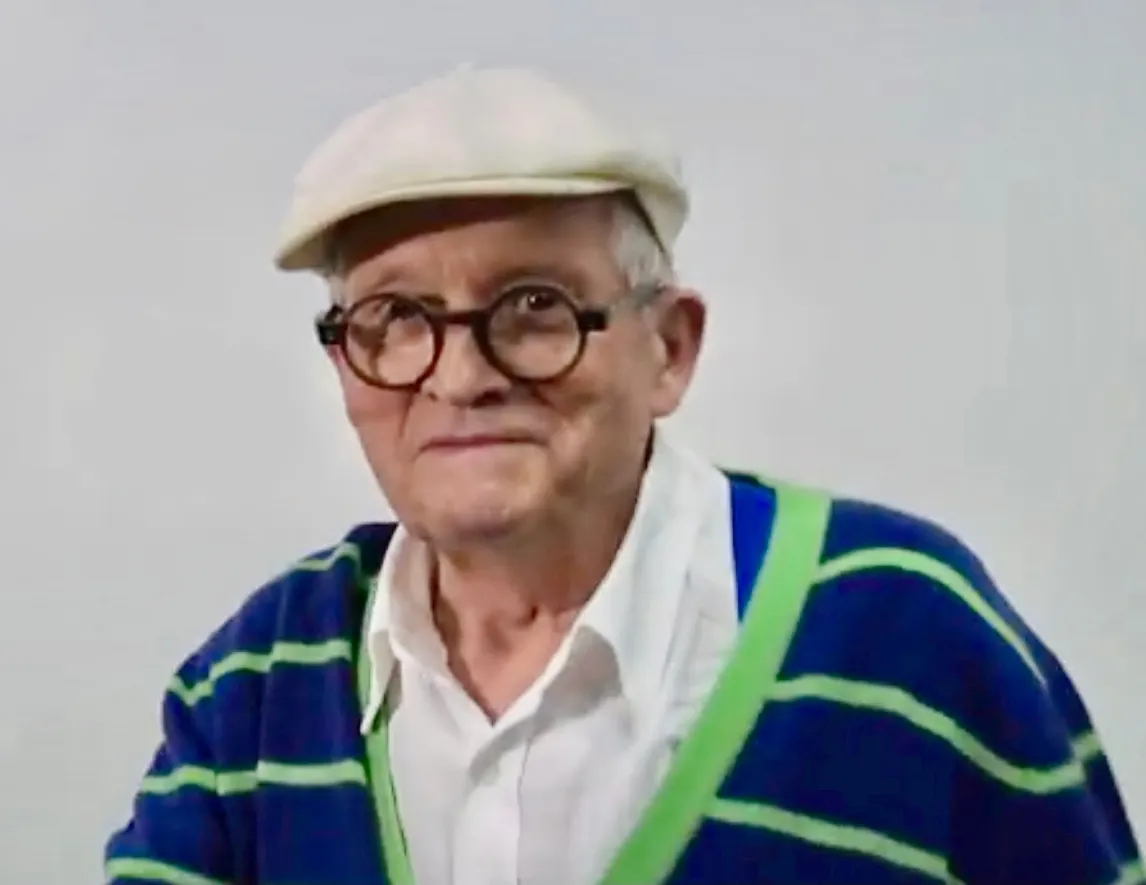
David Hockney spent six decades making the ordinary glamour of a sunlit swimming pool look like the most natural subject in the world. On Wednesday, June 11, the artist died peacefully at his home in London, a month short of his 89th birthday, his publicist Erica Bolton said. He was 88.
Hockney was, by almost any measure, the most widely recognized living British painter — and one of the most commercially celebrated artists of his generation. His flat blue water, palm-lined patios and unsparing double portraits became a kind of visual shorthand for postwar California, even though he was born in the gray mill city of Bradford, in Yorkshire, and never lost the accent. The statement confirming his death called him “one of the most important figures in contemporary art in both the 20th and 21st centuries,” and the tributes that followed reached from the Tate to Buckingham Palace.
For American readers, Hockney’s loss lands close to home. The work that made him famous was made here — in Los Angeles, in the light he chased across Santa Monica and the Hollywood Hills, in the backyard pools he painted with an outsider’s delight. He arrived in California in the 1960s and effectively annexed it as his subject.
From Bradford to a Bigger Splash
Hockney was born in 1937 and trained at the Royal College of Art in London, where he emerged in the early 1960s as a leading figure in the British Pop art movement. But it was his move to Los Angeles that defined him. The flat acrylic surfaces, the geometry of diving boards and lawn sprinklers, the impossible blue of chlorinated water — Hockney found in Southern California a vocabulary no one had painted quite that way before.
His 1967 painting A Bigger Splash, with its frozen white plume of water and empty deck chair, remains one of the most reproduced images in modern art. He returned to the pool again and again, but he refused to stand still. Over the decades he reinvented his practice repeatedly: stitched-together Polaroid “joiners” that fractured a single scene into dozens of frames, full-scale opera set designs, vast multi-canvas Yorkshire landscapes painted after he moved back to England, and, in his later years, brightly colored drawings made on an iPad. He treated each new tool as a fresh box of paints rather than a gimmick.
King Charles, who knew Hockney personally, captured that restlessness in a statement released by Buckingham Palace. The King said he and the Queen were “greatly saddened to learn of the death of David Hockney, a giant of the world of art and painting, a Yorkshireman through and through, and a dear friend and inspiration to so many.” He remembered the painter as “one of life’s true originals; one who wore his genius as lightly as those beloved yellow Crocs of his that helped brighten Palace occasions.”
The Painting That Reset the Market
If Hockney’s reputation rested on his eye, his place in the record books rests on a single canvas. In November 2018, his 1972 work Portrait of an Artist (Pool with Two Figures) sold at Christie’s in New York for $90.3 million after roughly nine minutes of bidding — at the time, the most expensive work by a living artist ever sold at auction. The price blew past its estimate of around $80 million and stunned a market more accustomed to paying those sums for long-dead masters.
The painting itself is a quiet drama: a standing figure in a pink jacket, modeled on Hockney’s former partner and muse Peter Schlesinger, looks down at a swimmer gliding through green water beneath a mountain backdrop. Hockney reportedly began the work in 1971 after two unrelated photographs fell together on his studio floor. The record stood until 2019, when Jeff Koons reclaimed it, but the sale cemented Hockney as the rare painter who was both critically serious and a blue-chip financial asset — a status that will shape how his estate, his foundations and the museums that hold his work navigate the years ahead. Hockney’s market sat at the center of the broader culture and media beat American Courant tracks, where the line between artistic legacy and asset value keeps getting harder to draw.
A Life Lived in the Open
Hockney’s importance was never only about pools and prices. He was, from early in his career, openly gay at a time when homosexuality was still a crime in Britain — it was not decriminalized in England and Wales until 1967 — and he painted same-sex intimacy and affection with a tenderness that was, in its moment, quietly radical. Several commentators this week singled out that courage as central to his legacy, noting that he made queer life visible on gallery walls decades before it was safe or fashionable to do so.
Alex Farquharson, the director of Tate Britain, said in a tribute that “David was an endlessly inventive artist, with a unique vision of the world. He was always completely and courageously himself, both in his work and in life.” The Mayor of London, Sadiq Khan, called him “a revolutionary of British art who never stopped reinventing his work.” The through-line in nearly every tribute was the same: not just talent, but the refusal to repeat himself.
That reach extended well beyond the gallery class. Hockney’s major retrospectives became genuine popular events, drawing some of the largest crowds British museums had recorded for a living artist and pulling in visitors who rarely set foot in a contemporary art space. He was, in that sense, one of the last artists to be both critically canonical and broadly famous — a figure whose name and signature images were recognized by people who could not name another living painter. His willingness to chase mass audiences, whether through immersive light-and-music shows or freely shared iPad drawings, sat comfortably alongside the museum honors, and it is part of why his death registered far outside the art world.
What He Leaves Behind
Hockney leaves an enormous body of work spread across the world’s major collections, from the Tate to the museums of Los Angeles that helped make him. He also leaves a question the art world now has to answer — how to handle the legacy of an artist who was as much a popular figure as a critical one, beloved by audiences who do not otherwise set foot in galleries. Major retrospectives of his work, including recent and planned exhibitions in London and abroad, are likely to draw new attention in the months ahead, and institutions will weigh how to present a career that spanned oil paint and touchscreens with equal conviction.
His own view of his work was always forward-facing, more interested in the next picture than the last record. The King’s tribute closed on that note, mourning “a man whose irrepressible charm, talent and constant innovation will be most sorely missed, but whose dazzling creativity lives on.” For a painter who turned a backyard pool into something the whole world recognized, that creativity is the part that does not fade. The rest of our culture coverage will follow how his legacy is handled from here.
Sources 6 cited
- David Hockney, shape-shifting artist of global acclaim, dies at 88
- David Hockney dies — he was one of the 20th century's most influential artists
- David Hockney: Celebrated British artist dies at 88
- The art world honours David Hockney, 'who flew the flag higher than any other British artist'
- David Hockney's Famed Pool Scene Sells for $90.3 M. at Christie's, New Record for Work by Living Artist at Auction
- British artist David Hockney dies, aged 88
American Courant cites its sources and links to primary documents where they exist. How we report →