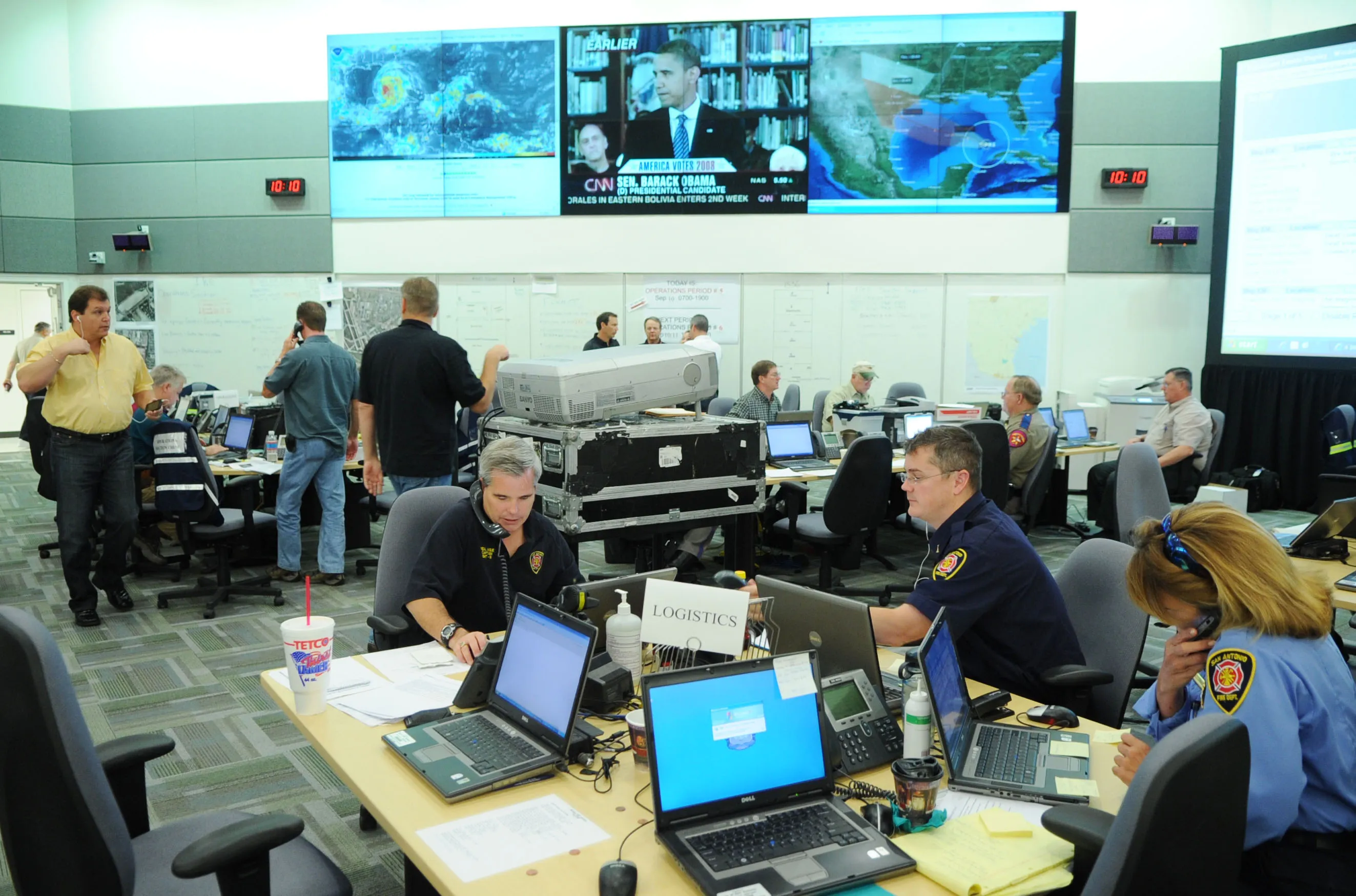
The 2026 Atlantic hurricane season began this morning. The Federal Emergency Management Agency’s acting administrator offered a frank public readiness summary for the country’s primary disaster response agency: “We are playing catch-up.”
That’s not a description of weather. Storms are unpredictable. The calendar is not. The policy decisions that left FEMA shorthanded on this specific date — made by identifiable officials, on a timeline anyone with access to a government almanac could have read — are a matter of public record.
This editorial isn’t arguing that FEMA will collapse when a storm hits. It will deploy responders. It has money in the Disaster Relief Fund. The argument is that the agency is materially weaker than it was two years ago, that it will remain weaker for the length of this hurricane season, and that the people responsible for weakening it did so while June 1 sat on the calendar, unchanged, the way it has every year since NOAA established the modern hurricane season.
The Choices That Got Here
Emergency management professionals began sounding alarms in early 2025, and not quietly.
The incoming administration opened that year with widely reported consideration of eliminating the Federal Emergency Management Agency entirely — transferring disaster response responsibilities to individual states, which have neither the financial capacity nor the logistics infrastructure to replicate what the federal agency does during a major disaster. That proposal, and the serious public discussion that surrounded it, produced immediate and predictable organizational consequences. Federal employees who had built careers in emergency management began to leave. Others accepted the administration’s voluntary buyout offers. Over roughly 18 months, FEMA lost more than 5,000 employees — approximately a fifth of its total headcount — through layoffs, buyouts, and resignations.
Cameron Hamilton, the administration’s own acting FEMA administrator, told the House Appropriations Committee in May 2025 that eliminating FEMA was not “in the best interest of the American people.” He was escorted from the building the following day. White House press secretary Karoline Leavitt confirmed the reason: Hamilton had taken a public position “contrary to what the president believes and the goals of this administration in regards to FEMA policy.”
The administration then imposed an internal approval requirement mandating explicit sign-off on all FEMA expenditures over $100,000. For an agency that routinely commits tens of millions of dollars to single disaster declarations, this created a bottleneck that froze routine operations for months. New DHS Secretary Markwayne Mullin, who replaced Kristi Noem in March 2026, eventually reversed the requirement — but the disruption had already run its course.
Meanwhile, federal funding for the Department of Homeland Security expired February 14, 2026. Congress allowed the DHS lapse to stretch 76 days, during which FEMA’s Disaster Relief Fund fell from $9.8 billion to $1.6 billion. On April 29 — 33 days before hurricane season — FEMA activated Immediate Needs Funding, its emergency posture when the DRF drops below $3 billion. Pending reimbursements to states and municipalities for already-completed disaster recovery work were paused. Everything non-urgent stopped.
The House passed the DHS Appropriations Act on April 30. The money came back. The employees did not.
The Calendar That Never Moved
None of this qualifies as a surprise in the operational sense. Hurricane season begins June 1 every year. The National Hurricane Center publishes this date. FEMA plans its entire operational cycle around it. Every coastal state emergency management office in the country uses it as a planning horizon.
The Senate unanimously passed the DHS funding bill on March 27. It passed again on April 2, after procedural complications. The House didn’t act until April 30. Those six weeks between Senate passage and House action ate directly into the pre-season runway — the period when FEMA would ordinarily be ramping up staffing, running exercises, and pre-positioning resources for the months ahead.
The agency now carries more than 300,000 open disaster projects across 600 active disaster declarations, recovery work owed to communities across the country from prior storms. Processing, auditing, and closing those projects requires trained staff. The 300 priority hiring positions FEMA was authorized to fill as of May represent a fraction of the 5,000 it lost. Federal hiring takes months. Specialized emergency management training takes additional months on top of that. You cannot rebuild an agency’s institutional knowledge on a six-week runway against a deadline that everyone knew was coming.
Eighteen of FEMA’s 38 senior leadership positions are vacant. Fourteen employees who signed a public warning letter to Congress last August about disaster preparedness were placed on paid administrative leave as a response. They were told they would return to work before hurricane season — which is not a description of continuity but of late-stage reassembly.
What “Below-Normal” Does Not Guarantee
NOAA’s official 2026 hurricane season forecast, released May 21, projects a below-normal year: 8 to 14 named storms, 3 to 6 reaching hurricane strength, 1 to 3 becoming major hurricanes. The suppression is driven primarily by expected El Niño conditions, which historically reduce Atlantic activity.
It would be a mistake to read “below-normal” as a safety guarantee.
Hurricane Katrina struck in 2005 during a record-setting season of 28 named storms — exceptionally active. Hurricane Harvey, which dropped 60 inches of rain on Houston in 2017, arrived during a season that was active but not historically unusual. Hurricane Helene killed more than 200 people across six states in 2024, with the worst casualties in inland western North Carolina — a region with no historical precedent for catastrophic hurricane flooding, and no reason to expect it until it arrived. None of those death tolls were significantly connected to whether the seasonal storm count was above or below average.
A single major hurricane striking a populated coastline, or a storm that tracks unexpectedly inland, tests the full depth of FEMA’s capacity regardless of what the rest of the season looks like. The agency doesn’t get to triage storms by available staffing. It responds to whatever actually hits.
The administration’s fiscal situation adds another constraint. Following the Moody’s downgrade of U.S. sovereign debt in May and the ongoing Senate debate over the budget reconciliation bill, there is limited political appetite for mid-season supplemental disaster appropriations. FEMA enters this season with what it has.
What the Re-Nomination Concedes
The most direct evidence that the administration understands what it created is the re-nomination of Cameron Hamilton on May 11, 2026.
Hamilton was removed in May 2025 for publicly defending the agency he was running. Nominating him again a year later — after a disaster season, after congressional hearings, after the visible collapse in staffing and financial reserves — is functionally an acknowledgment that the approach of early 2025 was wrong. If treating FEMA as a bureaucratic target had been sound policy, there would be no basis for reinstating the official who was dismissed for opposing that approach.
The re-nomination does not restore the 5,000 employees who left. It does not fill the 18 vacant senior leadership positions. It does not process the 300,000-project backlog or undo the organizational disruption of a year and a half of leadership uncertainty. The Senate has not yet scheduled confirmation hearings. FEMA enters the 2026 hurricane season under acting leadership, with a workforce it is trying to rebuild, against a caseload that grew larger while the workforce shrank.
The Accountability Question
Acting Administrator Bob Fenton has said he is “confident” in FEMA’s ability to respond when storms form. He is a capable emergency manager who has navigated the agency through difficult periods. When a hurricane develops this season, FEMA will respond — that is not in serious question.
What deserves a serious question is how effective, how fast, and how sustained that response will be, given the organization FEMA actually is today — not the agency it was before the disruption, and not the agency it will be once a new permanent director is confirmed, new hires are trained, and the backlog has been worked down. Those conditions won’t exist for months, and hurricane season runs through November 30.
When the season tests FEMA’s capacity — and a season that runs six months will eventually test whatever capacity the agency has — the question worth asking is: how did it get here?
That question has a specific, public answer. It is a sequence of choices, made on a predictable timeline, by identifiable officials. The storms didn’t make those choices. American communities in the path of this season’s weather didn’t make them either.
Sources 6 cited · 3 primary
- FEMA Announces Implementation of Immediate Needs Funding as Disaster Relief Fund Continues to Deplete
- NOAA predicts below-normal 2026 Atlantic hurricane season
- H.R.7744 — Department of Homeland Security Appropriations Act, 2026
- FEMA leadership vacancies spark concerns ahead of hurricane season
- Trump nominates Cameron Hamilton, fired after defending FEMA, to lead the agency
- Acting FEMA chief Bob Fenton on incoming hurricane season: 'We are playing catch-up'
American Courant cites its sources and links to primary documents where they exist. How we report →